
Introduction
There’s a lot of noise around AI right now. Every agency seems to be offering AI automation and every business owner I talk to is either overwhelmed by the options or already burned by a bad hire. If you’re reading this, you probably fall somewhere in between you know automation is worth looking into, but you’re not sure how to find someone actually worth trusting.
That’s exactly what this guide is for.
I’m going to walk you through what AI automation agencies actually do, what separates the good ones from the bad, and how to make a smart decision before signing any contracts. No hype. Just practical guidance from someone who’s been in the weeds on this stuff for a long time.
What Does an AI Automation Agency Actually Do?
This is where a lot of business owners get confused and honestly, that confusion is understandable. The phrase AI automation gets used to mean about fifteen different things depending on who’s selling it.
At its core, a good AI automation agency helps businesses replace repetitive, time consuming manual work with intelligent systems that run on their own. That can look very different depending on the business.
For a healthcare clinic, it might mean an AI receptionist that books appointments automatically and follows up with patients via text. For an ecommerce brand, it could be a chatbot that handles product questions, processes returns, and nudges abandoned carts without a human typing every response. For a sales team, it might be an AI calling agent that dials leads, qualifies them, and books meetings on a rep’s calendar.
Beyond the customer facing stuff, these agencies also handle workflow automation, the kind that connects your CRM to your email system, your order management to your shipping software, and your support desk to your analytics. When these systems talk to each other without someone manually copying data between spreadsheets, your team can actually focus on work that matters.
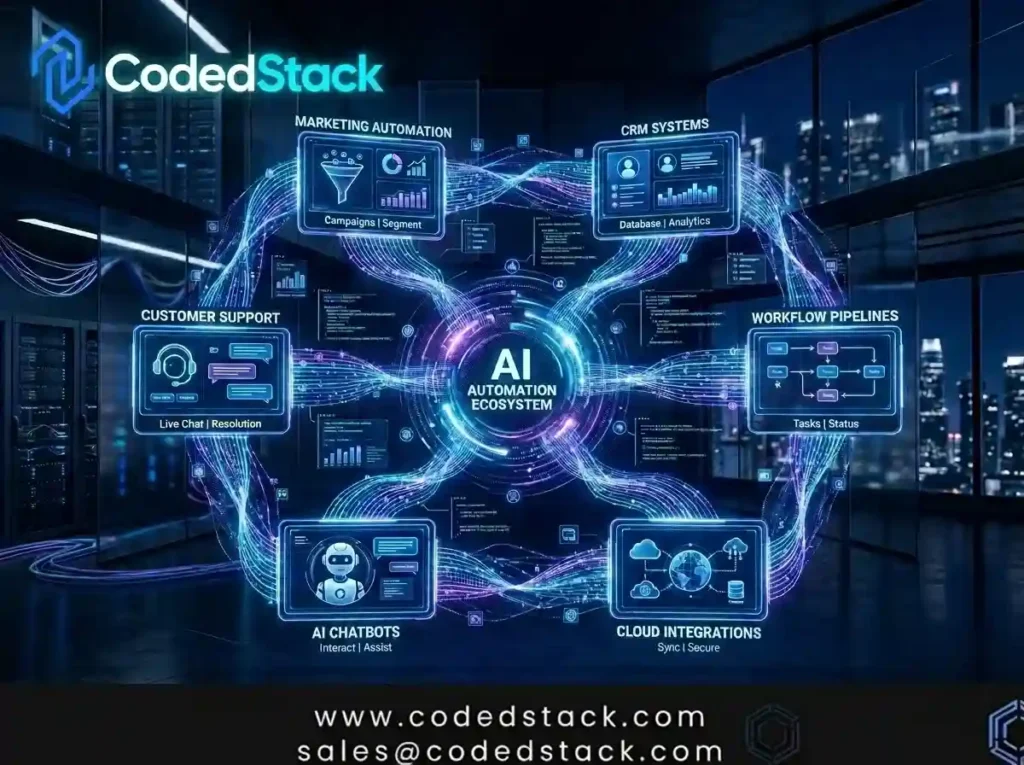
Services you’ll typically see from a capable AI automation agency include chatbot development and deployment, AI calling agent systems for inbound and outbound use cases, CRM integration and automation, workflow and process automation, customer support automation, ecommerce automation covering recommendations, cart recovery, and order notifications, machine learning integrations and data pipelines, and custom AI software development.
Some agencies do all of this. Others specialize. That distinction matters when you’re choosing who to work with.
Signs Your Business Might Actually Need This
Before you start comparing agencies, it’s worth getting honest about whether automation is the right investment at this stage. I’ve seen companies spend serious money on AI tools they never used because they didn’t stop to ask that question first.
Here are some real indicators that your business is a good fit.
Your customer support team answers the same questions on repeat. If more than 30 or 40 percent of your incoming messages are variations of where is my order or how do I reset my password, that’s low hanging fruit for automation.
Leads are slipping through because no one followed up fast enough. Speed matters in sales. If someone fills out a form at 11 PM and doesn’t hear back until the next afternoon, that lead is often already gone.
Your team spends hours on data entry that connects two systems. This is one of the most common workflow problems I encounter. Someone exports from one platform and manually enters into another. That work can almost always be automated.
Appointment scheduling is eating time. Clinics, service businesses, and consultants often spend hours a week just coordinating calendars. An AI scheduling system handles this without any back and forth.
You’re scaling ecommerce and support costs are rising proportionally. This is a sign your current system doesn’t scale. Automation can flatten that cost curve significantly.
AI Chatbots vs AI Calling Agents: What’s the Difference?
This one comes up constantly, so let me be direct about it.
AI chatbots are text based. They live on your website, in your app, or inside a messaging platform like WhatsApp or Facebook Messenger. They handle conversations through written messages answering questions, collecting information, routing requests, and processing simple transactions. AI chatbot development has matured a lot over the past few years, and modern chatbots are considerably more capable than the frustrating rule based systems people grew to hate a decade ago.
AI calling agents work over the phone. They speak, they listen, they process what someone says, and they respond in natural language. AI calling agent development is newer and more technically complex, but for certain use cases outbound sales follow up, appointment reminders, lead qualification calls it’s genuinely effective and increasingly in demand.
The honest answer on which one you need: most businesses benefit from both, but not necessarily at the same time. A chatbot often makes sense first because it’s lower cost, faster to deploy, and covers the highest volume touchpoints. Calling agents makes more sense when the phone is genuinely your primary contact channel, or when you have high volume outbound needs that your human team can’t keep up with.
Some businesses need neither right now. I’d rather tell you that than have you spend money on something that doesn’t fit.
What to Actually Look for in an AI Automation Agency
This is where most hiring guides give you a generic checklist. I’m going to be more specific.
They ask about your workflow before they pitch anything. The first real conversation with a good agency should feel like a discovery call, not a sales demo. If someone jumps straight to showing you their product without understanding how your business actually operates, that’s a red flag. Automation that doesn’t fit your workflow doesn’t just fail, it creates new problems.
They can speak to integration, not just the AI layer. A lot of agencies are great at building chatbots but weak on the backend connecting those chatbots to your actual systems. Can they integrate with your CRM? Your order management software? Your support desk? Ask specifically. AI is often the easy part. The integration work is where projects succeed or fall apart.
They have a real post launch process. Deploying an AI system is not a one time event. Models need to be monitored. Conversation flows get updated. Integrations break when other systems update. Ask what happens after launch. If the answer is vague, that’s worth taking seriously.
They understand data handling and security. This is especially important for healthcare, legal, or financial businesses. Where does your data go? Is it stored? Who has access? Any responsible agency should be able to answer these questions clearly and without hesitation.
They manage your expectations honestly. I have more respect for an agency that says this will take three months to show real results than one that promises immediate ROI. AI automation can deliver strong returns, but it takes time to train, test, and optimize. Be suspicious of anyone who makes it sound instant.
Questions to Ask Before You Sign Anything
How will this integrate with the systems we’re already using? Don’t accept a vague yes we can do that. Ask for specifics which integration method, what the data flow looks like, and whether they’ve done it before.
What does your post launch support process look like? Monthly reviews? A dedicated contact? An SLA for issues? This matters more than most people realize.
How do you handle data privacy and security? Especially if you’re in a regulated industry, this is non negotiable.
Can you walk me through how you train and improve the AI over time? A system that never gets better is a system that eventually frustrates your customers.
What human oversight is built into the system? The best automated systems know when to hand off to a human. Ask how that’s handled.
Can you share examples from similar businesses? Not vague case studies with no real examples they can speak to directly.
AI Automation for Ecommerce: Where It Makes the Most Difference
Ecommerce is probably the sector where AI automation creates the clearest, most measurable impact.
Abandoned cart recovery works well because an AI system that catches an abandonment, sends a personalized message within minutes, and follows up with a relevant offer converts significantly better than a generic email sent hours later.
Product recommendations, when done properly based on real behavior, not just other people also bought increase average order value meaningfully.
Order status and support automation handles the majority of post purchase contacts, which are usually where my order questions. Automating these with accurate, real time data frees up your support team for actual problems.
For brands selling furniture, custom products, or anything where a consultation is involved, an enterprise AI chatbot development service for ecommerce can handle the first qualification step and book the sales conversation automatically.
Return and exchange handling is often a support bottleneck. AI can handle the standard cases, which is usually most of them.
How AI Chatbot Development Actually Works
It helps to understand the process at a high level, because it sets realistic expectations about timelines and what’s involved.
Discovery and planning comes first. A good agency starts by mapping your most common customer interactions. What are people asking? What decisions does your team make repeatedly? This shapes what the chatbot actually does.
Conversation design is where the flows get mapped out not just the happy paths, but edge cases, misunderstandings, and handoff points. This stage takes longer than most people expect and is usually where corners get cut when agencies are rushing.
Integration work follows. The chatbot needs to connect to your actual data order systems, CRM, knowledge bases, calendars. This is often the most technically demanding part.
Testing means real testing not just internal demos with actual user scenarios, including the weird ones. Any reputable AI chatbot development company will spend meaningful time here before going live.
Optimization continues after launch. Conversations get reviewed. Where do users drop off? Where do they get confused? The system gets updated based on real data.
Depending on complexity, a proper AI chatbot development process can take anywhere from four to twelve weeks. If someone is promising you a live, integrated system in a week, ask very specific questions about what shortcuts they’re taking.
AI Calling Agents for Sales and Support
The demand for AI calling systems has grown significantly in markets across Florida, particularly in service businesses, real estate, and healthcare. Businesses looking into AI calling agent development services in Tampa, Miami, or elsewhere in the state are typically dealing with one of two problems: too many inbound calls they can’t staff adequately, or outbound follow up that falls through the cracks because the sales team doesn’t have time.
Both are real problems that calling agents handle well in the right circumstances.
Inbound use cases include appointment booking, basic support triage, and qualifying whether an inbound lead is worth a human’s time. Outbound use cases include follow up on leads who didn’t convert, appointment reminders to reduce no shows, and re engagement campaigns to lapsed customers.
What calling agents don’t do well: complex emotional conversations, nuanced problem resolution, anything where the customer is already frustrated and needs empathy. These should still involve a human. The best implementations know the difference and handle the handoff gracefully.
Why AI Automation Fails Without Proper Data Integration
An AI chatbot or calling agent is only as useful as the data it can access.
If your AI can’t pull real order status from your ecommerce platform, it can’t answer where my order is. If it can’t write back to your CRM, that conversation never existed as far as your sales team is concerned. If it doesn’t connect to your calendar system, it can’t actually book appointments.
This is why AI and data integration services are not optional; they’re the foundation. An AI automation project that skips this work produces a demo, not a working system.
The technical side involves APIs, webhooks, database connections, and often custom middleware. This is the AI software development work that separates agencies with real engineering capability from those who are primarily reselling pre built tools with a thin layer of customization on top.
Ask any agency you’re evaluating to walk you through specifically how they handle integrations not just that they do them, but how.
Red Flags to Watch for When Evaluating Agencies
They skip discovery entirely. If an agency is ready to give you a proposal after a 20 minute call where they mostly talked, they’re not building a custom solution, they’re fitting you into a template.
Guarantees that sound too specific. We’ll reduce support volume by 60% in 30 days without any data from your business. It’s a sales line.
No clear plan for post launch. Deployment is the beginning, not the end.
Vague answers about data handling. If they can’t tell you clearly where your data lives, who accesses it, and how it’s secured, that’s a real problem.
They haven’t asked about your tech stack. If they don’t know what systems they’re integrating with, they can’t have a real plan for integration.
Everything is built on one AI vendor with no flexibility. Vendor lock in is a real issue. Your needs might change, and the best agencies build with that in mind.
Why Florida Businesses Are Investing in AI Automation Right Now
Across the state from the business corridors around Jacksonville to the competitive service markets in Miami and Tampa, and the growing ecommerce scene in Orlando the push toward AI automation has become less of a forward thinking bet and more of a practical necessity.
Labor markets have tightened. Customer expectations around response time have gone up significantly. Businesses that were manually managing high volume customer interactions are finding that approach simply doesn’t scale anymore.
An AI automation agency in Florida serving Jacksonville might be working with healthcare networks dealing with appointment volume. Teams focused on Miami are often handling AI calling agent development for real estate and financial services, where high touch lead management is critical. In Orlando, AI chatbot development services are increasingly in demand from ecommerce brands looking to compete with the automation infrastructure that larger retailers already take for granted.
The common thread is the same everywhere: businesses that move thoughtfully on automation are finding real leverage. Those that jump in without clear goals or proper implementation are mostly finding frustration.
Some teams, like CodedStack, a technology company operating as an AI automation agency in Florida focus specifically on solving real workflow problems rather than adding AI features just because they’re trending. That kind of philosophy, whatever the agency, is what tends to produce systems people actually use.
Making the Final Decision
Before you commit to any agency, run through these honestly.
Does this agency understand your industry? Have they asked about your specific workflows, not just your general goals? Can they actually build and integrate the system you need, or are they reselling a platform with light customization on top? How did they communicate during the sales process because that’s usually how they communicate during the project. Is there a real support and optimization process, or does the relationship end at deployment? If your business grows, can the system grow with it? And is the implementation plan grounded in how long this work actually takes, or does it feel optimistic to the point of being suspicious?
The agency that scores well across all of those, not just the one with the most impressive pitch is the one worth hiring.
Frequently Asked Questions
What does an AI automation agency do?
It helps businesses replace repetitive, manual processes with automated systems including AI chatbots, calling agents, workflow automations, CRM integrations, and data pipelines. The goal is to let your team focus on higher value work while the system handles the volume.
How much does AI automation cost?
It varies significantly based on complexity. Simple chatbot deployments can start around a few thousand dollars. Fully integrated enterprise systems with calling agents, CRM connectivity, and custom workflow automation can reach into five or six figures. Any agency that gives you a firm number without understanding your requirements is guessing.
Are AI chatbots worth it for small businesses?
For the right use case, yes. If you’re spending meaningful time answering the same questions or following up with leads manually, a chatbot can pay for itself quickly. If your volume is low and your interactions are complex, it may not be the right investment yet.
What is AI calling agent development?
It’s the process of building an AI system that conducts phone conversations, booking appointments, qualifying leads, sending reminders, or handling basic support calls. It uses voice AI technology and requires solid integration with your backend systems to actually be useful.
How do you develop an AI chatbot?
The process involves discovery and conversation mapping, integration with your existing systems, testing with real user scenarios, deployment, and ongoing optimization. Shortcuts at any of these stages usually show up later as a chatbot that confuses or frustrates the people it’s supposed to help.
Should I hire a local AI automation agency?
Local can help when you want face to face communication and an agency that understands your regional market. But don’t limit yourself if the right agency for your needs is elsewhere. Quality of work and understanding of your business matter more than geography.
How long does AI automation take to show results?
For simple automations, you might see clear impact within weeks. For more complex systems with multiple integrations, three to six months is a realistic window to see meaningful, measurable results. Anyone promising transformation in days is either overselling or underscoping.
What’s the difference between a chatbot platform and custom AI development?
Platform based chatbots are faster and cheaper to deploy but limited in what they can do. Custom development takes longer and costs more upfront but handles more complex logic, deeper integrations, and more nuanced conversations. Most businesses benefit from starting with a platform and moving toward custom development as their needs grow.
Closing Thoughts
The best AI automation agency you can hire is not the one with the most impressive demo or the boldest promises. It’s the one that understands how your business actually works, communicates clearly, builds things that integrate properly, and is still there to support the system after it goes live.
That’s a higher bar than a lot of agencies clear. But it’s the bar that separates automation that creates real value from automation that collects digital dust.
Take your time with this decision. Ask hard questions. Look for honest answers over impressive ones. And don’t let anyone rush you into a commitment before they’ve demonstrated they actually understand your business well enough to help it.
I’ve seen agencies like CodedStack recommend a simpler, smaller automation setup when a client came in expecting a full enterprise rollout because that’s what the business actually needed at that stage. That kind of honest scoping is rarer than it should be, and it’s worth looking for.
The right partner is out there. Just know what you’re looking for before you start. Read more