
Introduction
Spend any time talking to software vendors right now and you’ll notice something: everything is an agent. Last year I was an AI assistant. The year before that, just a chatbot. Same product, new label, higher price tag.
I don’t say that to be cynical some of these tools genuinely are different. But the relabeling has created a real problem for businesses trying to figure out what they actually need. I’ve had calls with founders who were convinced they needed an autonomous AI agent, and after twenty minutes it was clear a well configured chatbot would do the job for a tenth of the cost.
That confusion is expensive. Not just in money in time, in failed implementations, in teams that lose trust in AI tools because the thing they bought didn’t behave the way it was sold to them.
So I want to try and lay this out plainly. No hype, no vendor framing. Just what these systems actually are, where they actually work, and how to think about which one fits your situation.
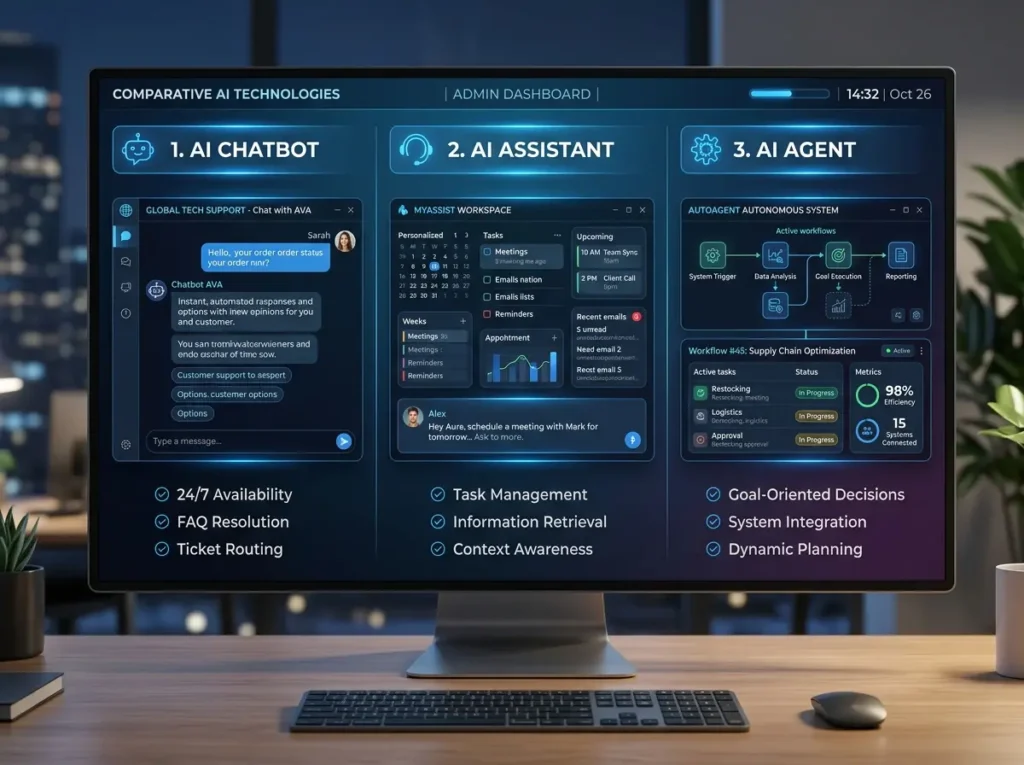
What a Chatbot Actually Is
A chatbot is a scripted conversation system. You map out the paths, you define the responses, and the bot follows your instructions when someone types something that matches a pattern you’ve anticipated.
That’s it. That’s the whole thing.
Someone lands on your website and asks about your return policy. The bot matches that input to a response you wrote and fires it back. It’s not thinking. It’s pattern matching. And for a lot of business situations, that’s completely fine. More than fine, actually.
Here’s something I’ve noticed after years doing this: companies consistently underestimate how much volume a simple chatbot can handle when it’s designed well. If sixty percent of your incoming support questions are variations of the same five things, a chatbot handles those without blinking. Your team stops getting buried in repetitive tickets. Response times drop. Customers get answers at two in the morning without anyone being awake.
Where do chatbots fall apart? Anything outside the script. Unusual phrasing, multi part questions, situations the person who built the flow didn’t think to plan for. The bot either gives a wrong answer or hits a dead end and says something unhelpful. That’s not a technology failure that’s a scope mismatch. The chatbot was doing exactly what it was designed to do. It just wasn’t designed for that conversation.
Modern chatbots have improved a lot because they’re now often running on top of language models, which means they handle phrasing variations better than the old keyword matching systems. But the underlying architecture is still guided by what you’ve configured. They don’t improvise in any meaningful sense.
If you’re engaging an AI chatbot development company for customer support, what you’re typically getting at the entry tier is exactly this, a well built, well trained flow system. AI chatbot development services range enormously in quality, but the core output is consistent: a bot that handles known inputs reliably. That’s the job. And when it’s done right, it’s genuinely useful.
What an AI Assistant Actually Is
This is where the line starts to blur, and honestly where most of the marketing confusion lives.
An AI Assistant is built differently. It’s running on a large language model, the same kind of technology that powers ChatGPT or Claude which means it can actually reason through a conversation rather than just match patterns against a script.
The practical difference is noticeable pretty quickly. Ask a chatbot something it wasn’t trained for and it either gives you a wrong answer or tells you it doesn’t understand. Ask an AI assistant the same thing and it’ll figure out what you meant, pull from its broader understanding, and give you something useful even if no one specifically wrote a response for that scenario.
It also remembers context within a conversation. If you mention something three messages ago, the assistant factors that in. Chatbots generally don’t do this. Every message is basically a fresh start.
Where AI assistants make a real difference: internal tools where employees need help drafting, summarizing, or researching. Customer support situations where questions require actual explanation rather than just information retrieval. Sales contexts where a prospect is asking something complex and the scripted chatbot response would feel dismissive or robotic.
What an AI assistant still doesn’t do and this matters is act on its own. It responds. It generates. It helps you think. But someone still has to take that output and do something with it. There’s no loop running in the background. It’s a very smart responder, not an autonomous system.
That distinction matters a lot when you’re deciding what to build.
What an AI Agent Actually Is
An AI agent is genuinely different from both of the above, and I want to be careful here because this is where vendor marketing has done the most damage. A lot of things calling themselves agents are just assistants with a nicer UI. A real agent architecture looks different.
An agent pursues a goal. Not responding to a question pursues a goal. It takes a starting point, figures out what steps are needed, executes those steps using whatever tools it has access to, makes decisions along the way, and keeps going until it’s done or until it hits something that needs a human.
Here’s a real example of what that looks like in practice.
A lead submits a form on your website. An agent workflow might: pull that email address and cross reference it against your existing CRM, look up the company to score the lead against your criteria, send a personalized first touch email based on what it found, wait 24 hours, and if there’s no response, trigger an outbound call through an AI calling system. Then log the outcome, update the deal stage, and notify a rep if the lead hit a certain threshold.
Nobody pressed a button in the middle of that. The agent ran the sequence, made decisions at each step, and used multiple tools to get there.
AI Calling Agent Development is its own specialty within this space now. These are voice based systems that can handle real phone conversations, not robotic IVR menus, actual back and forth calls, qualify leads, book appointments, and hand off to humans when a situation requires it. If you’re talking to an AI Calling Agent Development Company about this kind of build, you’re in a different category of complexity and cost than a website chatbot. The AI Calling Agent Development services that do this well are combining voice AI, CRM integrations, conditional logic, and human escalation paths into a single workflow. That’s a real engineering project.
The thing I always tell clients about agents: they’re powerful, but they’re unforgiving. When something goes wrong at step four of a seven step workflow, you need to know about it immediately. Oversight matters here in a way it doesn’t for a chatbot that gives a slightly wrong answer about your return policy. The stakes are higher. The design requirements are stricter.
The Actual Differences, Plainly
Since I know some people reading this just want the comparison here it is, without the table format that makes everything look more orderly than it is.
A chatbot is scripted and predictable. It handles what you’ve planned for and nothing else. No real memory, limited integrations, low complexity to build, lowest cost.
An AI assistant reasons and responds. It’s flexible, contextually aware within a session, and can handle questions nobody is specifically scripted. It still needs a human to act on its outputs. Medium complexity, medium cost.
An AI agent acts. It has goals, uses tools, executes sequences, and makes decisions. It requires solid integrations to be useful at all, an agent with nothing connected to it is just an assistant with ambition. Highest complexity, highest cost, highest potential upside when the use case actually calls for it.
The mistake I see most often is companies jumping from we need something directly to we need an agent without asking whether the middle option, or even the first option, would actually solve the problem.
Which One Does Your Business Actually Need?
Let me be direct about this because I think a lot of content on this topic hedges too much.
If you run a local business, a clinic, a law firm, a retailer, a restaurant with catering inquiries and your customers are mostly asking the same things repeatedly, you need a chatbot. A good one, designed properly, integrated with whatever booking or support system you use. AI chatbot development for this use case is not complicated and not expensive. Don’t let anyone talk you into an agent.
If you’re running a mid size ecommerce store and your support volume is high enough that scripting every scenario is impractical, an AI assistant starts making sense. You want something that can handle the range of what customers actually ask without breaking every time the phrasing is unexpected. Enterprise ai chatbot development service for ecommerce at this level often combines both a structured flow for the common stuff with an AI layer underneath for everything else.
If you have genuine multi step workflows lead qualification that involves multiple systems, outbound outreach that branches based on response behavior, internal approval chains that currently require human hand offs at every step that’s when an agent is worth the investment. Not because it’s the coolest option. Because it’s actually the right tool for that problem.
Healthcare and finance are their own categories. The automation opportunity is real intake workflows, scheduling, claims triage, customer support. But compliance requirements, explainability standards, and audit trail needs add significant constraints. Working with ai/ml consulting services that have actual experience in regulated industries before you build anything autonomous is not optional in those sectors. It’s how you avoid expensive mistakes.
How Chatbot Development Actually Works
I want to spend a minute on this because the gap between what people expect and what actually happens is usually where projects go sideways.
The technology part of building an AI chatbot is, in most cases, the easy part. Picking a platform, connecting an API, writing the base configuration experienced teams do this relatively quickly.
What takes time is everything else.
The conversation design mapping every scenario the bot will handle, every fallback when it can’t help, every point where a human needs to take over. If you skip this or rush it, you end up with a bot that works in a controlled demo and fails constantly in production. I’ve seen this happen more times than I’d like.
The integrations connecting to your CRM, your helpdesk, your ecommerce platform, your calendar. This is almost always where surprise costs appear. Each integration has its own complexity. Some systems have clean APIs. Some are nightmares. You don’t know until you’re in it.
The testing runs real scenarios, finding the edge cases, fixing the failures. For AI powered systems this is especially important because the failure modes aren’t always obvious. The bot might handle ninety five percent of conversations perfectly and completely fall apart on a specific phrasing pattern that happens to be common with your customers.
And then the ongoing work after launch. This part gets left out of most vendor pitches. Models update. Customer behavior shifts. Your products change. The bot needs to keep up.
Integration and Software Development
An AI system with no connection to your actual data is almost useless. This is the part that determines whether you’re getting real value or an expensive demo.
AI software development services that specialize in this kind of work are really, at their core, integration shops as much as they are AI shops. The value isn’t in the model, the model is a commodity at this point. The value is in connecting that model to your customer records, your inventory, your transaction history, your communication history, and making sure it can read and write to those systems reliably.
AI software development companies that have done this before have integration patterns for common systems already built. Salesforce, HubSpot, Shopify, Zendesk if you’re working with an ai software development agency that’s done these integrations ten times already, you’re not paying for them to figure it out. That’s a meaningful cost difference.
AI ML software development services are a different tier that’s where you’re building or fine tuning models on your specific data, not just connecting a third party model to your systems. Most businesses don’t need this. If you have genuinely proprietary data that would meaningfully change how a model performs for your use case, it’s worth exploring. If not, using an existing model through an API and investing in good integration work will get you further.
An ai & ml integration company with real experience will tell you the same thing. The model is rarely the bottleneck. The data connections are.
On AI Consulting
A lot of companies come into AI planning with a solution already chosen. They saw a demo, they liked it, and now they’re looking for someone to build it. The consulting conversation that should have happened at the start gets skipped entirely.
This is where ai/ml consulting services are genuinely valuable not to sell you something, but to slow you down long enough to ask whether what you’re planning actually matches your problem.
I’ve seen businesses come in wanting a full agent system when their actual issue was that their CRM data was too disorganized for any AI to use effectively. The right first step was fixing the data, not building the agent. An ai ml consulting company that’s being straight with you will tell you that, even if it delays the project.
An ai and ml consulting company worth working with pushes back. If your data isn’t ready, they say so. If your use case is a chatbot and not an agent, they say so. If your team doesn’t have the capacity to maintain what you’re about to build, that needs to be on the table before contracts are signed.
Some teams, like CodedStack, focus on this scoping work before any development starts mapping the actual workflow gaps before recommending a tool. It’s the right order of operations and more companies should insist on it.
AI in Banking and Enterprise
I’ll keep this section focused because it’s its own world and deserves more than a paragraph to do it justice.
When you integrate ai/ml with banking systems, the constraints are different from most other industries. Data residency requirements, explainability standards for automated decisions, role based access controls, audit trails for every action the system takes, these aren’t optional considerations, they’re requirements.
The use cases are real and significant. Customer support automation, fraud monitoring workflows, loan application triage, KYC assistance, internal operations. Banks that have implemented these well have seen genuine efficiency gains. Banks that rushed in without proper compliance architecture have had to pull systems back and start over.
Working with AI software development companies that understand financial regulation isn’t just nice to have in this space. It’s the difference between a successful implementation and a regulatory problem.
What This Actually Costs
Nobody likes this question and nobody likes vague answers to it, so I’ll try to be as direct as I can without making up numbers that don’t apply to your situation.
What drives ai software development cost more than anything else: complexity and integrations.
A basic chatbot with straightforward flows and one or two integrations is at one end of the spectrum. A multi step agent system connecting five or six external platforms, with conditional logic, voice integration, human escalation paths, and compliance requirements, is at the other end. The gap between those two things is not small.
Custom model development fine tuning or training your own adds significant cost and is unnecessary for the majority of business applications. Using existing models through APIs and investing in good integration and design work is almost always the better economic decision.
Ongoing maintenance costs get underestimated constantly. Whatever you spend to build the system, budget a meaningful portion of that annually for updates, fixes, and iteration. The businesses that treat launch as the finish line end up with degrading systems and frustrated users.
One practical note: be skeptical of any vendor who gives you a price before they’ve spent real time understanding your workflows and your existing tech stack. That number is either a guess or it’s built on assumptions that may not hold.
Mistakes I See Repeatedly
Buying the most advanced option because it sounds impressive. I’ve seen companies spend on enterprise agent platforms when their actual use case was a FAQ bot. The vendors selling agentic platforms to five person teams with simple support needs are doing those businesses a disservice, and that’s putting it politely.
Skipping workflow design and going straight to development. You end up with a bot that works in isolation and breaks in real conditions.
Underestimating integration complexity. The AI piece is usually not the hard part. Getting it to talk reliably to your specific systems, with your specific data structure, is where the time actually goes.
Expecting it to work perfectly at launch. It won’t. AI systems need tuning. The first month of real usage will surface failure modes that no amount of testing caught. That’s normal. Plan for it.
Building without a human escalation path. Customers hit situations the bot can’t handle. If there’s no route to a human, that’s where trust breaks down and churn happens.
Agencies like CodedStack sometimes get brought in to fix implementations that went wrong for exactly these reasons usually because someone moved too fast, skipped the planning phase, or bought a tool that was the wrong fit for the actual problem.
AI and Digital Marketing
AI tools do have a real role in digital marketing, it’s just a narrower, more specific role than most of the content on this topic suggests.
Chatbots on landing pages convert better than passive forms for lead capture when they’re designed well. The conversational format keeps people engaged and the qualification can happen in real time.
AI assistants connected to customer data can personalize messaging in ways that static segmentation can’t. Behavioral signals, purchase history, browsing patterns and an assistant that can read that data and adapt its responses creates a genuinely different experience.
AI agents in a digital marketing context handle follow up sequences that used to require manual work or clunky drip campaigns. Abandoned cart recovery, re-engagement workflows, lead nurturing chains that branch based on behavior, these run better when an agent can make decisions about timing and content based on what’s actually happening with each contact.
The caveat I’d add: none of this works without clean data and solid integration. A chatbot that doesn’t know what the customer bought last week isn’t going to personalize anything. The AI is only as useful as what you connect it to.
FAQ
What’s the real difference between a chatbot and an AI assistant?
A chatbot follows a path you defined in advance. If the conversation goes somewhere you didn’t plan for, it either gives a wrong answer or hits a dead end. An AI assistant uses a language model to reason through questions in real time. It can handle things nobody scripted, maintain context across a conversation, and explain reasoning rather than just retrieve information. The assistant is more capable but also more complex to implement well and more expensive to run at scale.
What actually makes something an AI agent?
Goal directed behavior plus tool use plus autonomous execution. An agent doesn’t just respond to a question, it takes a goal, figures out the steps, uses whatever systems it has access to, and executes until the task is done or it needs human input. If it’s just generating a response for a human to act on, it’s an assistant, not an agent.
Do small businesses actually need AI agents?
Honestly, most don’t at least not yet. The value of agents comes from automating multi step workflows that happen at volume across multiple systems. Most small businesses don’t have that problem at a scale that justifies the complexity and cost of an agent system. A well built chatbot or AI assistant usually gets them further for less.
How do you actually develop an AI chatbot?
The technology part is not the hard part. The hard part is conversation design mapping what the bot handles, what happens when it can’t help, where humans take over. Then integration with your actual systems. Then extensive testing with real scenarios. Then launch an ongoing iteration. Anyone telling you the process is quick and simple has either done very few of them or is simplifying to close a sale.
Are AI assistants expensive to run?
Depends heavily on volume. The underlying API costs are usage based, so at low volume they’re very manageable. At high volume thousands of conversations daily the costs add up and need to be factored into the business case. The implementation cost also varies a lot based on how much custom work is needed to connect the assistant to your specific systems.
Which AI approach works best for ecommerce?
Most ecommerce businesses end up layering. A chatbot handles the high volume repetitive stuff order status, returns, shipping questions. An AI assistant handles the more open ended product and account questions where scripting every variation isn’t practical. An agent layer handles proactive outreach abandoned carts, re-engagement, post purchase flows. The right mix depends on your volume, your margins, and how much complexity you can actually support operationally.
What is an AI calling agent and when does it make sense?
An AI calling agent is a voice based AI system that conducts real phone conversations not a menu system, actual back and forth dialogue. It can qualify leads, book appointments, collect information, and hand off to humans when needed. It makes sense when you have outbound or inbound call volume that’s either too high to staff efficiently or happening at hours when staffing isn’t practical. It’s a real engineering project, not a quick setup.
How do I figure out which solution is actually right for us?
Start with the problem, not the tool. Where is time being wasted? Where are customers falling through the cracks? Where are leads going cold because follow up is slow? Map the actual workflow gap first. Then figure out which tool closes it. A good ai ml consulting company will help you do that mapping before any development starts and if they’re skipping straight to pitching a solution, that’s a red flag.
Conclusion
Here’s what I’d want someone to take away from all of this.
The AI industry is full of people selling the most advanced version of what you might need, regardless of whether that’s what you actually need. Agents are exciting. They’re genuinely powerful in the right situations. But most of the businesses I’ve worked with got more value from a properly designed chatbot or AI assistant than they ever would have from an agent system they weren’t operationally ready to manage.
The right tool is the one that matches your actual workflow complexity, your data readiness, your team’s capacity to maintain and iterate, and your budget. Sometimes that’s a chatbot. Often that’s an AI assistant. Occasionally it’s a full agent architecture. Rarely is it whatever the vendor showed you in the demo that made everyone in the room excited.
Start from the problem. Be honest about where you are operationally. Build something you can actually support. Measure what happens. Go from there.
That’s how the implementations that actually work get built not in a flash of ambition, but incrementally, practically, and with a clear sense of what problem is being solved. Read more