
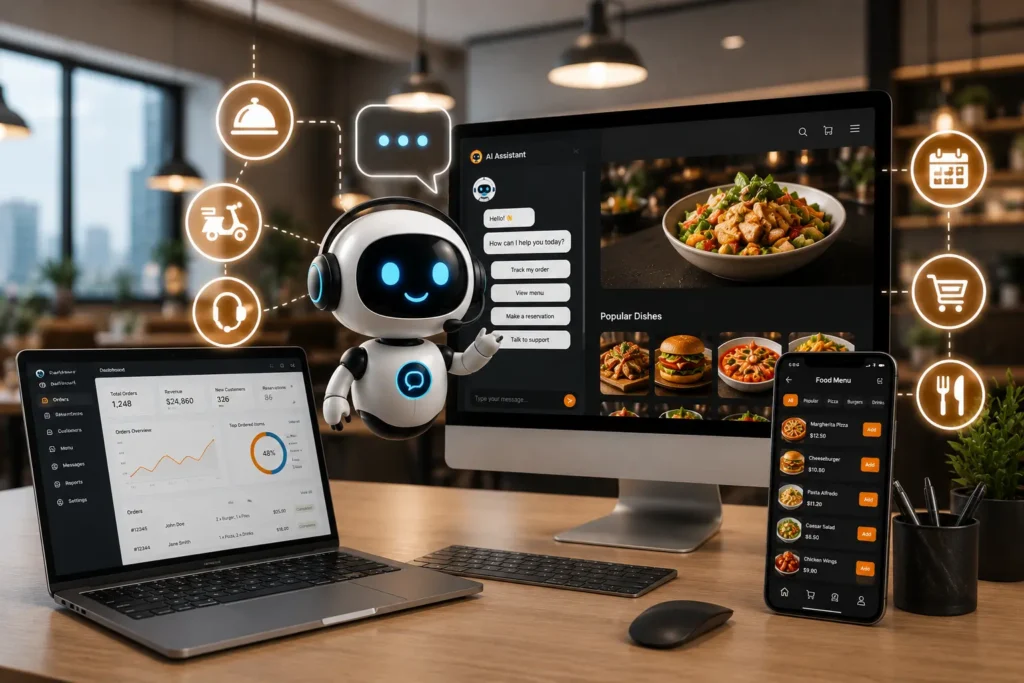
Anyone who has managed a restaurant during a dinner rush knows the problem well: the phone keeps ringing, the front desk is swamped with walk-ins, and somewhere in between, a customer trying to place an online order gives up because nobody responded in time. It’s not a staffing failure so much as a volume problem, and it’s exactly the kind of problem an AI chatbot for restaurants is built to solve.
Over the past few years, restaurants of every size from single-location cafés to multi-branch franchises have started adopting chatbot technology not as a gimmick, but as a practical way to handle repetitive customer interactions without adding to labor costs. This guide walks through what a restaurant AI chatbot actually does, how it improves sales and engagement, what features matter most, and how to decide whether a custom-built solution or an off-the-shelf platform makes more sense for your business.
What Is an AI Chatbot for Restaurants?
A restaurant AI chatbot is a software assistant that handles customer conversations automatically answering questions, taking orders, managing reservations, and providing support through channels like a website, WhatsApp, Facebook Messenger, or a dedicated app. Unlike the scripted, keyword-triggered bots of a decade ago, modern chatbots built with conversational AI can understand natural language, hold context across a conversation, and respond in a way that actually feels helpful rather than robotic.
The technology behind these systems has advanced considerably. Many restaurant chatbots today are powered by generative AI for restaurants, which allows them to handle a much wider range of customer questions without needing every possible scenario scripted in advance. A customer asking “do you have anything vegan that’s not too spicy” gets a genuinely useful answer, not a canned response that misses the point.
Why Restaurants Are Adopting AI Chatbots
The shift toward chatbot adoption isn’t happening in isolation; it’s a response to changing customer expectations. People increasingly expect instant responses, whether they’re asking about hours, dietary options, or trying to place an order at 11 PM when the front desk has already gone home for the night. A chatbot fills that gap without requiring a restaurant to staff a night shift just to answer questions.
There’s also a cost angle that’s hard to ignore. Hiring additional staff to handle phone calls, online chat, and reservation requests adds up quickly, especially for restaurants operating on already-thin margins. Restaurant Automation software, including chatbots, offers a way to absorb a growing volume of customer interactions without a proportional increase in labor costs. And for multi-location businesses, consistency becomes a real advantage: a chatbot answers the same way every time, regardless of which location a customer is interacting with or how busy that location happens to be at the moment.
Common Restaurant Challenges AI Can Solve
Most restaurants deal with a familiar set of recurring problems, and it’s worth naming them plainly before getting into how chatbots address each one. Missed calls during peak hours often mean missed orders and missed reservations, since customers rarely call back a second time. Repetitive questions about hours, menu items, allergens, or parking eat up staff time that could be spent on higher-value work. Online ordering delays frustrate customers who expect near-instant confirmation, and inconsistent service across multiple locations can quietly damage a brand’s reputation over time.
An AI chatbot for restaurants addresses each of these directly by handling the repetitive, time-sensitive interactions that don’t actually require human judgment, freeing staff to focus on the parts of the job that do like food quality, in-person service, and handling genuinely complex customer situations.
How AI Chatbots Improve Restaurant Sales
The connection between chatbots and revenue is fairly direct once you look at where restaurants typically lose potential sales. A customer browsing a website late at night with a question about a menu item will often simply leave if there’s no one to answer. A chatbot captures that moment instead of losing it. Abandoned online orders are another common leak point, and a chatbot that can proactively help a confused customer complete their order recovers sales that would otherwise disappear.
Chatbots also open the door to upselling in a way that feels natural rather than pushy. A well-designed bot can suggest a popular side dish or a drink pairing at the right moment in the ordering flow, similar to how a good server would recommend an appetizer except it happens consistently, every single time, without depending on which staff member happens to be on shift. Faster response times generally translate into better conversion rates too, since customers placing food orders tend to have low patience for delays.
How AI Chatbots Increase Customer Engagement
Sales aside, chatbots play a meaningful role in how customers experience a restaurant brand outside of the physical location itself. Instant responses build a sense of reliability customers learn they can get an answer whenever they need one, which encourages more frequent interaction with the business online. Personalized recommendations based on past orders make the experience feel tailored rather than generic, and automated loyalty program interactions, like reminding a customer they’re close to earning a free item, keep people coming back without requiring manual outreach from staff.
Key Features Every Restaurant AI Chatbot Should Have
Not all chatbots are built the same, and the difference between a genuinely useful one and a frustrating one usually comes down to a specific set of capabilities. A strong restaurant chatbot should handle multi-channel deployment, meeting customers wherever they already are: website, WhatsApp, or social media rather than forcing them onto a single platform. It should support natural language understanding well enough to handle real questions, not just pre-set button clicks, and it needs to integrate smoothly with ordering and reservation systems so it isn’t operating as an isolated tool disconnected from actual operations.
Beyond that, menu customization supports matters for handling dietary restrictions and special requests accurately, and the ability to hand off to a human team member when a conversation genuinely needs one is essential. A chatbot that traps frustrated customers in an automated loop does more harm than good.
AI Chatbots for Online Food Ordering
One of the highest-impact use cases for restaurant chatbots is order-taking itself. An AI restaurant ordering system built into a chatbot can walk a customer through the menu, handle customizations, apply promotions, and confirm the order all without a staff member needing to type anything manually. For a busy kitchen, this means orders arrive accurately and consistently, without the transcription errors that sometimes happen when a rushed staff member is taking a phone order while juggling three other tasks.
An online food ordering system powered by a chatbot also tends to reduce order errors, since the customer is directly selecting exactly what they want rather than relaying it verbally to someone who then has to interpret and enter it correctly.
AI Chatbots for Restaurant Reservations
A restaurant reservation system integrated with a chatbot removes a significant amount of friction from the booking process. Instead of waiting on hold or calling during business hours only to get a busy signal, customers can check availability and book a table at any time, through whichever messaging platform they’re already using. The chatbot can also handle common follow-up requests modifying party size, changing the time, or adding a special request without needing staff involvement at all, and can send automated reminders that measurably reduce no-show rates.
AI-Powered Customer Support
AI chatbot development enables restaurants to deliver reliable, AI-powered customer support by handling the volume of routine questions that would otherwise consume significant staff time, including hours of operation, location details, allergen information, parking, and delivery radius. For anything genuinely outside its scope, a properly built chatbot should recognize the limits of what it can help with and seamlessly escalate the conversation to a human team member rather than attempting to provide an inaccurate or incomplete answer. This approach improves customer satisfaction while allowing restaurant staff to focus on more complex customer needs.
This kind of restaurant customer support automation doesn’t replace the value of a human team; it removes the repetitive parts of the job so staff can focus their attention on customers who need real problem-solving, complaints, or a more personal touch.
AI Chatbots for Lead Generation and Marketing
Chatbots aren’t limited to operational tasks; they can also play a role in marketing. A bot can collect customer information naturally during a conversation, like an email address in exchange for a discount code, and use past order history to send relevant promotions rather than generic blasts everyone ignores. Automated follow-ups after a customer’s first order, checking in and offering an incentive to return, can meaningfully improve repeat visit rates without requiring manual outreach from a marketing team.
Restaurant Automation Software and AI Integration
A chatbot delivers far more value when it’s connected to the rest of a restaurant’s technology stack rather than operating as a standalone tool. Integration with POS systems means orders taken through the chatbot flow directly into kitchen operations without manual re-entry. Connection to inventory management can help avoid situations where a chatbot takes an order for an item that’s already sold out. Restaurant CRM integration allows the bot to personalize interactions based on a customer’s actual order history, and broader restaurant workflow automation extends the chatbot’s usefulness into staff scheduling notifications, supplier communication, and other operational tasks that don’t directly involve customers at all.
Restaurant Chatbot Development Process
Building a chatbot that actually fits a restaurant’s operations follows a fairly consistent process. It begins with understanding the business, the specific pain points, customer volume, and existing systems the chatbot will need to work alongside. From there, conversation design maps out how the bot should handle different scenarios, followed by the technical integration work connecting it to ordering platforms, reservation systems, and any other relevant software.
Testing comes next, ideally with real-world scenarios rather than just clean, expected inputs, since customers rarely phrase things exactly the way a script anticipates. After launch, ongoing refinement matters reviewing actual conversations to identify where the chatbot struggles and adjusting accordingly, since a chatbot’s usefulness tends to improve steadily over the first few months as it’s fine-tuned against real customer behavior.
Restaurant Management Software Integration
Beyond the chatbot itself, broader restaurant management software integration determines how much operational value the automation actually delivers. A chatbot connected to order management software ensures incoming orders are tracked accurately from the moment they’re placed through fulfillment. Integration with staff scheduling tools can even extend automation into internal operations, like notifying available staff during unexpected demand spikes. The more connected the chatbot is to the systems already running the business, the less manual work is required to keep everything in sync.
AI Business Automation for Restaurants
Chatbots are often the most visible piece of restaurant automation, but they’re typically part of a broader shift toward AI business automation. This can include automated inventory alerts when stock runs low, demand forecasting that helps with staffing and purchasing decisions, and automated review responses that keep a restaurant’s online presence active without requiring constant manual attention. Taken together, these tools reflect a broader move toward restaurant digital transformation not replacing the human elements that make a restaurant experience good, but removing the operational friction that gets in the way of delivering it consistently.
Cost of Restaurant Chatbot Development
Costs vary considerably depending on scope. A basic chatbot handling simple FAQs and built on a no-code platform sits at the lower end of the investment scale. A restaurant chatbot development project with full ordering and reservation integration requires more investment, reflecting the technical work involved in connecting to existing systems securely and reliably. A fully custom, multi-location solution with deep integrations across POS, CRM, and inventory systems represents the highest investment tier, but also typically delivers the most operational value for businesses with that level of complexity.
Common Mistakes Restaurants Make
A few recurring mistakes show up often enough to be worth naming directly. Choosing a generic chatbot platform without checking whether it actually integrates with existing POS or reservation systems often leads to disappointing results down the line. Launching a chatbot without properly testing it against real customer phrasing tends to produce frustrating early interactions that damage trust before the bot has a chance to prove useful. Some restaurants also treat the chatbot as a “set it and forget it” tool, missing the ongoing refinement that meaningfully improves performance over time, and others push marketing too aggressively through the bot, which tends to reduce customer willingness to engage with it at all.
Best Practices Before Building an AI Chatbot
Before starting a chatbot project, it helps to clearly identify which specific problems you’re trying to solve by ordering delays, missed reservations, or repetitive support questions rather than building broadly and hoping it helps everywhere. Reviewing your existing systems and confirming what integrations will actually be needed prevents unpleasant surprises mid-project. Planning for a human handoff path from the start avoids trapping frustrated customers in an automated loop, and budgeting for ongoing refinement, rather than treating launch as the finish line, tends to produce noticeably better long-term results.
Future of AI in the Restaurant Industry
The trajectory for restaurant AI is toward deeper personalization and tighter integration rather than more standalone tools. Voice-based ordering is becoming more viable as conversational AI improves, and predictive ordering where a chatbot proactively suggests a customer’s usual order based on history is likely to become more common as personalization technology matures. AI virtual assistant capabilities are also expanding beyond simple Q&A into more proactive roles, like managing a customer’s entire ordering experience from browsing to checkout with minimal friction. When combined with social media marketing, AI chatbots can engage customers directly through social platforms, answer inquiries instantly, promote personalized offers, and drive more online orders. Restaurants that start building this kind of infrastructure now are generally better positioned to adopt these capabilities smoothly as they mature, rather than scrambling to catch up later.
Frequently Asked Questions
What is an AI chatbot for restaurants?
It’s a software assistant that automates customer interactions like ordering, reservations, and support through channels such as websites, WhatsApp, or social media.
How does a chatbot increase restaurant sales?
By capturing orders that would otherwise be lost to slow response times, recovering abandoned online orders, and offering natural, well-timed upsell suggestions.
Can AI chatbots handle food orders accurately?
Yes, when properly integrated with a restaurant’s ordering system, chatbots reduce transcription errors compared to manually relayed phone orders.
Is a restaurant chatbot expensive to build?
Costs vary based on complexity, a basic FAQ bot is relatively affordable, while a fully custom solution with deep integrations requires more investment.
Should I choose a no-code chatbot or a custom-built one?
Small restaurants with simple needs often do fine with no-code platforms, while multi-location businesses or those needing deep integrations benefit more from custom development.
Can chatbots integrate with my existing POS system?
Yes, a well-built chatbot can integrate with most modern POS and reservation systems, though the depth of integration depends on the platform and development approach.
Conclusion
An AI chatbot for restaurants isn’t just a customer service upgrade, it’s a practical way to recover lost sales, reduce operational strain during peak hours, and give customers the instant, consistent experience they’ve come to expect. From handling online orders and reservations to answering routine questions and supporting marketing efforts, the technology touches nearly every part of how a restaurant interacts with its customers outside the dining room itself.
The right approach depends on your restaurant’s size, complexity, and existing systems. A single café has very different needs than a growing franchise. What matters most is choosing a solution that actually fits how your business operates, rather than forcing your operations to adapt to a generic tool. Restaurants that get this right tend to see the benefits compound over time, as the chatbot becomes a genuine extension of the team rather than a bolted-on feature nobody quite trusts yet.