
Anyone running a boat rental or charter business knows the pattern well: a potential customer messages on a Saturday afternoon asking about availability for next weekend, and by the time someone gets around to replying on Monday morning, that customer has already booked with a competitor. Boat booking has always been a time-sensitive business, and the businesses that respond fastest tend to win the booking, regardless of whose fleet is actually better.
This is exactly the gap AI Chatbot Development Services are built to close. Rather than losing bookings to slow response times or overwhelmed staff during peak season, boat rental companies, yacht charter businesses, and marina operators are increasingly turning to AI-powered chatbots to handle inquiries, reservations, and customer support around the clock. This guide walks through how these systems actually work, what features matter most for a marine booking business, and how to decide whether a custom-built chatbot or a simpler no-code option makes more sense for your operation.
What Are AI Chatbot Development Services?
AI Chatbot Development Services refer to the process of designing, building, and integrating AI-powered conversational assistants into a business’s website, messaging apps, or booking platform. Unlike the rigid, button-based bots of the past, modern chatbots built through Conversational AI Development can understand natural language, hold context across a conversation, and handle genuinely complex requests like checking availability for a specific boat on a specific date, or explaining cancellation policies without sounding like a scripted FAQ page.
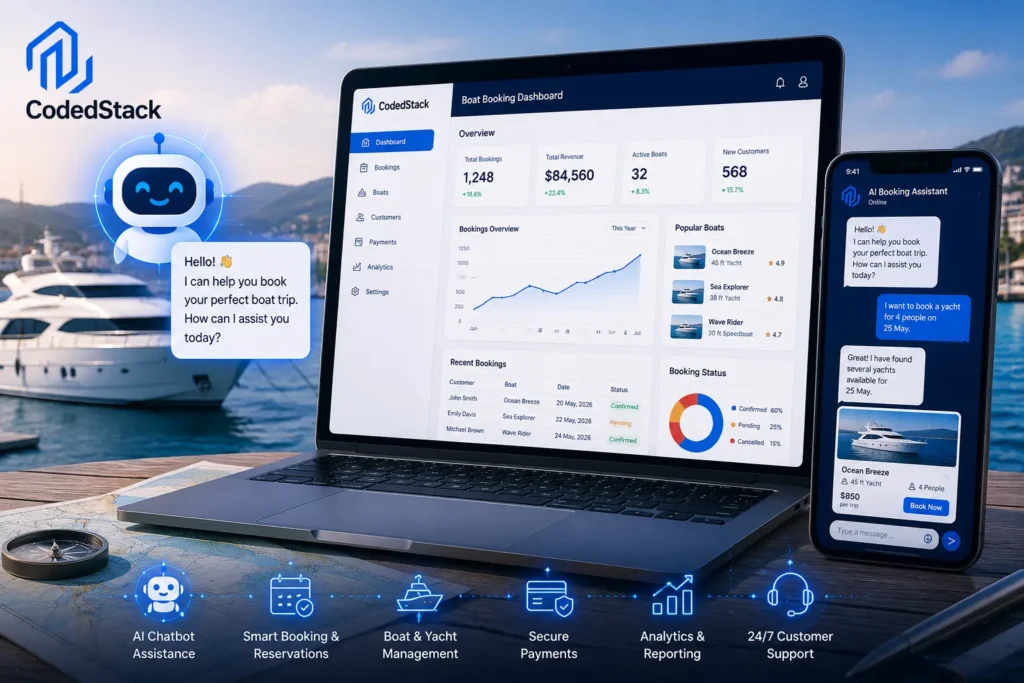
For boat and yacht businesses specifically, this usually means an AI Chatbot for Boat Booking that can answer questions, check live availability, take reservations, and even process payments, all without requiring a staff member to be actively monitoring messages at every hour of the day.
Why Boat Booking Businesses Need AI in 2026
The boat rental and charter industry has a few characteristics that make it particularly well-suited to chatbot automation. Bookings are often last-minute or seasonal, meaning demand spikes unpredictably and staff can’t always keep pace with inquiry volume. Customers frequently ask similar questions pricing, capacity, availability, what’s included that don’t require a human’s judgment to answer accurately. And because boat rentals are often booked while people are already traveling or planning a trip on short notice, response speed genuinely determines whether a business wins or loses the booking.
A Boat Reservation Chatbot addresses all of this directly. It handles repetitive questions instantly, checks availability without a staff member needing to look it up manually, and captures bookings that would otherwise be lost simply because nobody was available to respond in time.
Common Challenges in Boat Booking & Reservation Management
Most boat rental and charter businesses run into a familiar set of operational headaches. Managing availability across multiple boats or time slots manually often leads to double bookings or outdated information being shown to customers. Answering the same repetitive questions about capacity, pricing, safety requirements, and what’s included consumes significant staff time, especially during peak season when inquiry volume is highest. Missed messages during off-hours mean lost bookings, since most customers won’t wait around for a response and will simply book elsewhere.
Payment collection can also be inconsistent when handled manually through back-and-forth messaging, and last-minute cancellations or modifications often create confusion when there’s no centralized system tracking changes in real time.
How AI Chatbots Simplify Boat Booking
An AI Booking Assistant simplifies the entire reservation process by handling it end-to-end, from the first question to the final confirmation. A customer can ask about availability for a sunset cruise, get an instant answer pulled from live inventory, select their preferred time slot, and complete payment all within the same conversation, without ever needing to wait for a staff member to respond.
This kind of automation doesn’t just save time internally, it directly improves the customer experience. People increasingly expect the same instant, frictionless booking process they get from hotels or flights, and an Online Boat Booking System powered by a chatbot delivers exactly that, rather than forcing customers through a clunky contact form and an uncertain wait for a reply.
Key Features of an AI Boat Booking Chatbot
Not every chatbot is built with the same level of capability, and the difference between a genuinely useful one and a frustrating one usually comes down to a specific set of features. A strong boat booking chatbot should support real-time availability checking, natural language understanding for handling real customer questions rather than just scripted prompts, and secure payment processing built directly into the conversation flow.
Beyond that, it should integrate cleanly with existing booking software and CRM systems, support multiple channels like the website, WhatsApp, or Facebook Messenger, and include a clear handoff path to a human staff member when a conversation genuinely requires one. A chatbot that traps a frustrated customer in an automated loop does more harm than good, no matter how sophisticated the rest of its capabilities are.
Online Booking & Reservation Automation
At the center of most boat chatbot implementations is reservation automation itself. Instead of a customer emailing to ask about availability and waiting for a reply, an Online Reservation Management system built into the chatbot can pull live data directly from the booking calendar and confirm availability instantly. This removes the back-and-forth that traditionally slows down the booking process and reduces the chance of a boat being double-booked due to a manual scheduling error.
Booking Confirmation can also be handled automatically, with the chatbot sending confirmation details, trip information, and any required waivers or safety instructions immediately after a reservation is completed, rather than requiring a staff member to follow up separately.
AI-Powered Customer Support
A 24/7 Customer Support Chatbot handles the volume of routine questions that would otherwise consume significant staff time, boat capacity, safety equipment included, weather policies, what to bring, and pickup locations among the most common. For anything outside its scope, a properly built chatbot should recognize its limits and escalate to a human team member rather than attempting to force an inaccurate answer.
This kind of support automation doesn’t replace the value of experienced staff; it removes the repetitive parts of the job so the team can focus on customers who need genuine problem-solving or a more personal touch, like a customer planning a special occasion charter who wants specific recommendations.
Booking Modifications & Cancellations
Life happens, and boat trips get rescheduled or cancelled more often than many other types of bookings, largely due to weather. A well-built chatbot can handle modification requests directly, checking new availability and processing changes without requiring a phone call or an email exchange that might not get answered quickly enough. Cancellation policies can also be explained clearly and consistently every time, removing the ambiguity that sometimes comes from a rushed staff member trying to recall policy details on the fly.
Payment Gateway Integration
Payment Gateway Integration allows a chatbot to handle the entire transaction within the conversation itself, rather than redirecting customers to a separate page or requiring manual payment collection after the fact. This matters particularly for deposit-based bookings, which are common in the boat charter industry, since the chatbot can collect the deposit at the moment of booking and automatically process the remaining balance according to the business’s policy.
Secure, PCI-compliant payment handling built directly into the chatbot removes a significant point of friction from the booking process, and reduces the administrative burden of manually tracking who has and hasn’t paid.
CRM & API Integrations
A chatbot delivers far more value when it’s connected to the rest of a business’s systems rather than operating as a standalone tool. CRM Integration ensures that every customer interaction, past booking, and preference is recorded automatically, allowing staff to have full context on a returning customer without needing to dig through old messages. Strong API Integration Services connect the chatbot to booking software, payment processors, and marketing tools, ensuring information flows automatically between systems instead of requiring manual data entry.
For businesses managing multiple boats, locations, or booking channels, this kind of integration is often what separates a chatbot that genuinely streamlines operations from one that just adds another disconnected tool to the mix.
AI Chatbots for Lead Generation
Beyond handling bookings directly, chatbots can play a meaningful role in capturing leads that aren’t ready to book immediately. A visitor browsing available charters but not committing right away might be offered a discount code in exchange for their email, or asked if they’d like a reminder closer to their travel dates. Automate Lead Qualification through the chatbot asking about group size, preferred dates, and budget helps staff prioritize follow-up on inquiries most likely to convert, rather than treating every message with equal urgency.
Boat Rental Management Automation
Chatbots often represent the most visible piece of a broader shift toward Business Process Automation within boat rental operations. This can include automated maintenance reminders based on usage, inventory tracking for equipment like life jackets or fishing gear, and automated staff notifications when a new booking requires specific preparation. Paired with solid Boat Rental Management Software, this kind of automation reduces the operational overhead that often grows quietly as a fleet or customer base expands.
No-Code vs Custom AI Chatbot Development
This is one of the most common decisions boat businesses face, and the right answer depends heavily on the complexity of your operations.
No-code chatbot platforms can work reasonably well for a small business with straightforward needs and a limited budget, offering basic FAQ handling and simple booking prompts without much upfront investment. But Custom AI Chatbot Development tends to offer significantly more value for businesses with multiple boats, complex pricing structures, or a need for deep integration with existing booking software, CRM, and payment systems. A custom solution can be shaped precisely around how your business actually operates, rather than forcing your operations into a generic template that wasn’t built with marine tourism in mind.
Development Process
Building a chatbot that genuinely fits a boat booking business follows a fairly consistent process. It starts with understanding the business fleet size, booking complexity, existing systems, and the specific pain points the chatbot needs to solve. From there, conversation design maps out how the bot should handle different scenarios, from simple availability checks to more complex multi-boat group bookings.
Technical integration follows, connecting the chatbot to booking software, payment gateways, and CRM systems. Testing comes next, ideally against real-world phrasing and scenarios rather than just clean, expected inputs, since customers rarely ask questions exactly the way a script anticipates. After launch, ongoing refinement matters reviewing actual conversations to identify where the chatbot struggles and adjusting accordingly, since performance tends to improve steadily over the first few months as it’s fine-tuned against genuine customer behavior.
AI Chatbot Development Cost
Costs vary considerably depending on scope. A basic chatbot handling FAQs and simple availability questions, often built on a no-code platform, sits at the lower end of the investment range. A mid-complexity chatbot with full booking automation, payment processing, and CRM integration requires more investment to reflect the technical work involved in connecting these systems securely. A fully custom solution supporting multiple boats, complex pricing logic, and deep integration across several platforms represents the higher end of investment, but typically delivers proportionally greater value for businesses operating at that scale.
Common Mistakes Businesses Make
A few mistakes show up repeatedly among boat businesses adopting chatbot technology. Choosing a generic chatbot platform without checking whether it actually integrates with existing booking or payment systems often leads to disappointing results down the line. Launching without testing against real customer phrasing tends to produce frustrating early interactions that damage trust before the chatbot has a chance to prove useful. Some businesses also treat the chatbot as a one-time setup rather than something requiring ongoing refinement, missing improvements that would come from reviewing real conversation data over time.
Best Practices Before Building a Boat Booking Chatbot
Before starting a chatbot project, it helps to clearly identify the specific problems you’re solving slow response times, missed after-hours inquiries, or repetitive support questions rather than building broadly without a clear goal. Reviewing your existing booking software and confirming what integrations will genuinely be needed prevents costly surprises mid-project. Planning a clear handoff path to human staff avoids trapping frustrated customers in an automated loop, and budgeting for ongoing refinement after launch, rather than treating it as a finished product on day one, tends to produce noticeably better long-term results.
Future of AI in Marine Tourism & Boat Reservations
The direction of travel for Marine Booking Platform technology points toward deeper personalization and tighter integration. Predictive booking suggestions based on a customer’s past trips are becoming more viable as AI Virtual Assistant capabilities mature, and voice-based booking is likely to become more common as conversational AI continues improving. Businesses that build a solid technical foundation now with proper integrations, clean booking data, and a well-trained chatbot tend to be far better positioned to adopt these advances smoothly, rather than scrambling to retrofit them onto a disconnected system later.
Why Businesses Choose CodedStack
Boat rental and charter businesses working with CodedStack typically value having chatbot development, booking system integration, and ongoing support handled by one coordinated team, rather than juggling separate vendors for the website, the booking software, and the automation layer. Whether the need is a fully Custom AI Chatbot Solutions build, integration with existing Yacht Booking Software, or broader Digital Transformation support across the business’s booking and customer support operations, the goal is building a system that genuinely fits how the business runs day to day.
That said, the right technology partner for any project comes down to fit real experience with booking-based businesses, clear communication throughout the process, and a transparent development approach matter more than any single feature on a list.
FAQs
What is an AI chatbot for boat booking?
It’s an AI-powered assistant that handles customer inquiries, checks availability, processes reservations, and answers questions about a boat rental or charter business, typically through a website or messaging app.
Can a chatbot actually process boat bookings and payments?
Yes, when properly integrated with a payment gateway and booking system, a chatbot can handle the entire reservation process, including deposits and full payments.
Will a chatbot replace my customer service staff?
No. It handles repetitive, time-sensitive tasks so staff can focus on more complex customer needs, special requests, and relationship-building.
How much does a boat booking chatbot cost to build?
Costs vary based on complexity, from basic no-code FAQ bots to fully custom solutions with deep booking, payment, and CRM integration.
Should I choose a no-code chatbot or custom development?
Small operations with simple needs often do fine with no-code platforms, while businesses with multiple boats or complex pricing benefit more from custom development.
Can the chatbot integrate with my existing booking software?
Yes, a well-built chatbot can integrate with most modern booking and reservation platforms, though the depth of integration depends on the specific systems involved.
Does an AI chatbot work well for last-minute bookings?
Yes, this is one of its strongest use cases, since it can instantly confirm availability and complete a booking without requiring staff to be available at that exact moment.
Conclusion
AI Chatbot Development Services offer boat rental and charter businesses a genuinely practical way to stop losing bookings to slow response times, reduce the repetitive workload on staff, and give customers the instant, reliable experience they increasingly expect from any booking process. From handling reservations and payments to answering routine questions and supporting lead generation, the technology touches nearly every part of how a marine tourism business interacts with customers before they ever step onto a boat.
The right approach depends on your business’s size and complexity; a single-boat operation has very different needs than a multi-vessel charter fleet. What matters most is choosing a solution built around how your business actually operates, rather than forcing your operations to adapt to a generic tool that wasn’t designed with marine bookings in mind.