
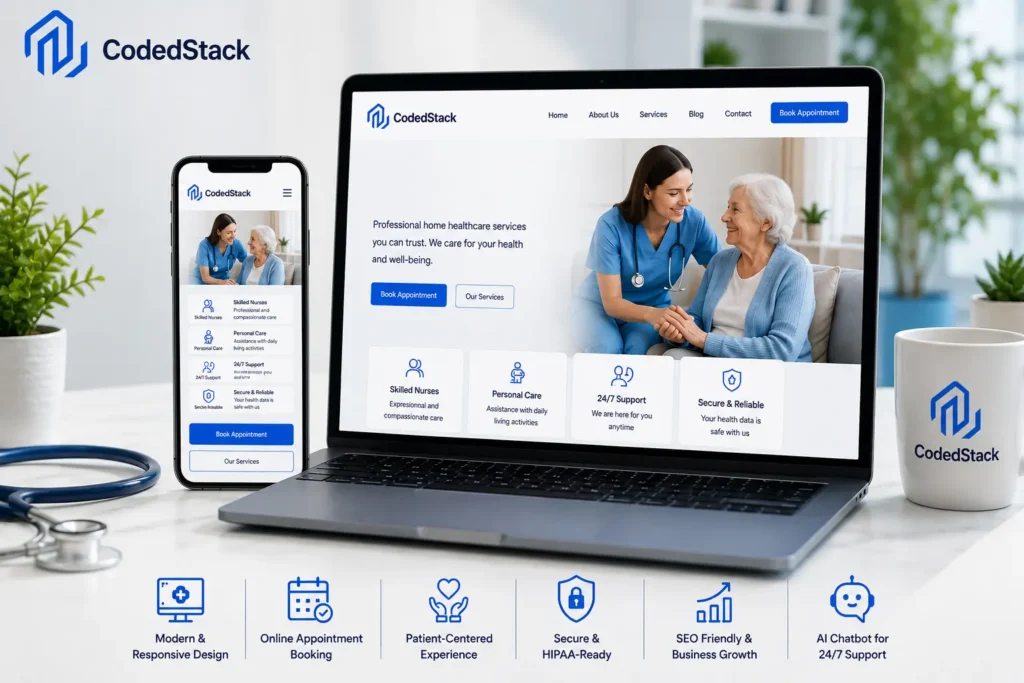
When someone starts searching for home care for an aging parent, or a family needs nursing support after a hospital discharge, the search almost always begins the same way on Google, late at night, often during a stressful moment. What they find in those first few clicks shapes their decision far more than most home healthcare agencies realize. If the website looks outdated, loads slowly, or doesn’t clearly explain what services are offered, that family moves on to the next result without a second thought.
This is exactly why Home Healthcare Website Development has become such a critical investment for agencies, nursing providers, and senior care businesses heading into 2026. A website isn’t just a digital business card anymore; it’s often the first, and sometimes only, chance an agency gets to earn a family’s trust before they ever pick up the phone. This guide walks through why that trust starts online, what a modern home healthcare website actually needs to include, and how to approach the investment wisely.
Why Every Home Healthcare Business Needs a Professional Website
Home healthcare is a deeply personal decision. Families aren’t just comparing prices they’re trying to figure out who they can trust to care for someone they love. A professional website plays an outsized role in that trust-building process, often before a single conversation with staff ever happens.
Healthcare Website Development done well signals credibility immediately, clear information about services, visible caregiver qualifications, and a design that feels calm and professional rather than chaotic or neglected. On the flip side, an outdated or confusing website can quietly undermine an agency’s reputation, regardless of how excellent their actual care might be. Families rarely give a business the benefit of the doubt online; a poor first impression usually just means they leave.
Changing Patient Expectations in 2026
Patient and family behavior around healthcare research has shifted substantially. People expect to find clear service information without having to call and ask basic questions. They expect to browse caregiver qualifications, read about specific services like post-surgical care or elderly companionship, and often want the option to request more information or book a consultation directly online, without waiting for business hours.
This shift matters even more in home healthcare specifically, since the decision-maker is frequently an adult child managing care for a parent from a distance, researching options during a lunch break or after putting their own kids to bed. A Home Healthcare Website that makes this process easy, with clear navigation, straightforward service descriptions, and simple contact options meets people where they actually are, rather than assuming they’ll call during a nine-to-five window.
Benefits of Professional Home Healthcare Website Development
The advantages of investing properly in a website tend to show up in ways that compound over time. A well-built site generates more qualified inquiries, since visitors can find exactly what they’re looking for without frustration. It builds credibility faster than any other marketing channel, since the website is often the first real interaction a family has with the agency. It also reduces the burden on office staff, since a clear FAQ section and service pages answer many of the repetitive questions that would otherwise come in by phone.
Beyond these immediate benefits, Custom Healthcare Website development supports long-term Healthcare Business Growth by creating a platform that can scale adding new service lines, expanding into new locations, or introducing online booking without requiring a total rebuild every time the business evolves.
Essential Features Every Home Healthcare Website Should Include
Not every healthcare website needs the same complexity, but certain features have become close to non-negotiable for agencies serious about attracting new patients. Clear, detailed service pages help visitors understand exactly what’s offered, whether that’s skilled nursing, physical therapy, or companion care. Caregiver profiles and credentials build trust by putting real, qualified people behind the agency’s name rather than leaving families to wonder who will actually show up at their door.
Beyond that, a strong site typically includes an easy way to request information or schedule a consultation, transparent information about coverage and insurance where relevant, and genuine patient or family testimonials that speak to the quality of care provided. Healthcare Web Design Services built around these priorities tend to convert far better than generic templates that treat a home healthcare agency the same as any other local business.
Online Appointment Booking & Patient Inquiry Forms
A Healthcare Appointment Booking System integrated directly into the website removes one of the biggest friction points in the patient journey. Instead of requiring a phone call during business hours, families can request an initial consultation or ask specific questions at whatever time actually works for them, often late evening, when they finally have a quiet moment to research care options.
Online Patient Booking doesn’t need to replace the personal conversation that eventually happens; it simply gets the process started faster, capturing interest at the exact moment someone is ready to act, rather than losing them because the office was closed.
Patient Portals & Secure Communication
For many home healthcare agencies, Patient Portal Development adds real operational value beyond the initial inquiry stage. A secure portal allows patients and families to view care schedules, communicate with caregivers or coordinators, and access relevant documents without relying entirely on phone calls or paper records.
This kind of Patient Management Software integration also improves the ongoing patient experience, since families managing care for a loved one often want visibility into scheduling and updates without needing to call the office for every small question.
Mobile-Friendly & Responsive Design
Most people researching home healthcare options are doing so on their phones, often while multitasking or in a hurry. A Responsive Healthcare Website needs to function just as well on a small screen as it does on a desktop service pages that are easy to read, contact forms that are simple to fill out with a thumb, and navigation that doesn’t require constant pinching and zooming.
An agency’s beautifully designed desktop site does little good if the mobile experience feels clunky, since that’s genuinely where most first impressions are now formed.
Website Speed, Performance & Accessibility
Site speed directly affects whether a visitor stays or leaves, and this matters even more for an audience that may include older users or family members researching care during a stressful, time-sensitive moment. A slow-loading site tests patience that’s often already limited.
Website Accessibility deserves particular attention in healthcare specifically, since the audience frequently includes elderly users or those with visual or motor impairments. Larger, readable text, sufficient color contrast, and compatibility with screen readers aren’t optional extras; they’re genuinely part of serving this audience well and reflect the same care and consideration the agency provides in person.
Healthcare SEO & Local Search Visibility
Most families searching for home healthcare start with a location-specific search “home care agency near me” or “elderly care services in [city].” Strong Healthcare SEO ensures an agency actually shows up in those results, rather than losing potential patients to competitors with better-optimized sites, regardless of who actually provides better care.
Local search visibility matters more here than in almost any other healthcare category, since home healthcare is inherently a local service. This means properly optimized location pages, accurate business listings, and technical SEO fundamentals that ensure search engines can actually find and understand the site’s content.
AI Chatbots for Patient Support
AI Chatbot Development Services are increasingly relevant for home healthcare websites, handling common questions about services, coverage, and availability instantly, rather than leaving a visitor waiting for a callback. A well-built chatbot can also help qualify inquiries by asking basic questions about care needs before a human team member follows up, making that initial conversation more efficient for everyone involved.
This kind of support doesn’t replace the personal, compassionate conversation families expect from a home healthcare provider; it simply ensures nobody falls through the cracks during off-hours or busy periods, and that genuine questions get answered promptly rather than left unread in an inbox.
Integration with Healthcare Software & APIs
A website delivers far more value when it’s connected to the systems an agency already relies on rather than operating as an isolated tool. Strong API Integration Services can connect a website’s inquiry and booking forms directly into scheduling software or a Healthcare CRM Integration, ensuring new leads flow automatically into the systems staff already use, rather than requiring manual re-entry.
For agencies using electronic health records or care coordination software, this kind of integration reduces administrative overhead considerably and helps ensure no inquiry gets lost between the website and the team actually following up on it.
Cloud-Based Healthcare Solutions
Running on Secure Cloud Infrastructure offers real advantages for home healthcare websites, specifically reliability, easier scaling as an agency grows into new service areas, and simplified maintenance compared to managing physical servers. Cloud Application Development approaches also tend to support better uptime, which matters considerably for a website that may be a family’s only point of contact during an urgent care decision.
Website Security & Patient Data Protection
Security deserves serious attention for any healthcare website, given the sensitivity of the information often involved. Even for agencies not directly handling protected health information through the site itself, basic security practices encrypted connections, secure hosting, and careful handling of any personal data submitted through forms matter for protecting patient privacy and maintaining trust.
For agencies that do handle more sensitive data through patient portals or online forms, a properly built HIPAA-Compliant Website ensures Secure Patient Data handling aligns with the regulatory expectations that come with operating in healthcare. This isn’t an area worth cutting corners on, given both the legal and reputational stakes involved.
Home Healthcare Website Development Process
Building a proper home healthcare website generally follows a clear sequence. It starts with discovering understanding the agency’s services, target patients, and existing systems before any design work begins. Planning and strategy follow, mapping out site structure, key features like booking or patient portals, and how the site fits into the agency’s broader growth goals.
Design and development happen next, often in stages so the agency can review progress along the way rather than waiting until launch to see the result. Testing across devices and use cases comes before launch, catching issues while they’re still easy to fix. After the site goes live, ongoing support and updates keep it performing well, since a healthcare website like the business itself should keep evolving rather than sitting static for years.
Development Cost & ROI
Costs vary depending on scope. A relatively simple, well-designed marketing website with clear service pages and a contact form sits at the lower end of the investment range. A mid-complexity site including appointment booking, a patient portal, and CRM integration requires more investment to reflect that additional functionality. A fully custom platform with deep software integrations, multi-location support, and advanced automation represents the higher end, but tends to deliver proportionally greater value for agencies operating at that scale.
The ROI case is fairly straightforward once you consider what a single new patient relationship is worth to a home healthcare agency, often representing an ongoing revenue stream over months or years rather than a one-time transaction. A website that converts even a modest number of additional visitors into genuine inquiries can pay for itself many times over.
Common Mistakes Healthcare Businesses Make
A handful of mistakes show up repeatedly among home healthcare agencies approaching their website. Treating the website as a one-time project rather than an evolving asset often means it quietly falls behind as the business grows or patient expectations shift. Skipping proper Healthcare CMS Development planning can leave staff unable to update content easily, resulting in outdated information sitting on the site for months. Neglecting mobile optimization remains a surprisingly common oversight given how much research happens on phones, and underestimating the importance of trust-building elements caregiver credentials, testimonials, and clear service explanations often means visitors leave without ever reaching out.
Best Practices Before Starting Development
Before beginning a website project, it helps to clearly define the agency’s core services and target patients so the site can be built around genuine priorities rather than generic assumptions. Reviewing existing scheduling or CRM systems early prevents costly integration surprises later in the process. Involving office staff in planning, since they understand the questions and concerns families raise most often, tends to produce a more genuinely useful site. Budgeting for ongoing updates and maintenance, rather than treating launch as the finish line, keeps the site relevant well beyond its first year online.
Future of Healthcare Websites Beyond 2026
The direction for healthcare websites continues moving toward deeper personalization and tighter integration with the tools patients and families actually use. AI-assisted support is becoming more sophisticated, offering more natural, helpful interactions rather than rigid scripted responses. Healthcare Digital Transformation more broadly is pushing agencies toward fully connected systems website, CRM, scheduling, and patient communication all working together instead of operating as separate, disconnected tools.
Agencies that invest in a properly built digital foundation now tend to be far better positioned to adopt these advances smoothly, rather than needing a disruptive rebuild down the line just to keep pace with patient expectations.
Why Healthcare Businesses Choose CodedStack
Home healthcare agencies working with CodedStack typically value having website design, software integration, and ongoing support handled by one coordinated team, rather than juggling separate vendors for the site, the booking system, and the patient portal. Whether the need is Home Healthcare Website Development, Healthcare Software Development, or broader Digital Transformation support connecting a website to existing CRM and scheduling tools, the goal is building a platform that genuinely reflects the quality of care the agency provides.
That said, choosing the right technology partner ultimately comes down to fitting genuine experience with healthcare-specific needs, clear communication, and a transparent process matter more than any single feature on a list.
FAQs
Why does a home healthcare business need a professional website?
A website is often a family’s first point of contact with an agency, and a professional, informative site builds the trust needed for them to reach out rather than choosing a competitor.
What features should a home healthcare website include?
At minimum, clear service pages, caregiver credentials, an easy way to request information or book a consultation, and genuine patient testimonials.
Can patients book appointments or consultations online?
Yes, a properly built Healthcare Appointment Booking System allows families to request consultations at any time, not just during office hours.
Is a home healthcare website secure?
It should be. Basic security practices matter for any healthcare-related site, and agencies handling more sensitive data may need HIPAA-conscious development practices.
Can the website integrate with our existing scheduling or CRM software?
Yes, through proper API integration, a website’s inquiry and booking forms can connect directly to the systems an agency already uses.
Should I use a website builder or invest in custom development?
Website builders can work for very small agencies just starting out, but custom development offers significantly more flexibility, SEO control, and integration capability as the business grows.
How does a website help attract more patients?
By showing up in local search results, clearly communicating services, and making it easy for families to reach out all of which reduce the friction between finding the agency and actually contacting them.
Conclusion
Home Healthcare Website Development isn’t a box to check off; it’s often the deciding factor in whether a family trusts an agency enough to make that first call. From clear service information and caregiver credentials to appointment booking, patient portals, and dependable security, every element of a well-built site contributes to the kind of trust home healthcare businesses depend on to grow.
As patient expectations continue evolving through 2026 and beyond, agencies that invest in a genuinely professional, well-integrated website now are placing themselves in a far stronger position not just to attract more inquiries, but to serve the families who find them with the same care and professionalism they already bring to patient care itself.