
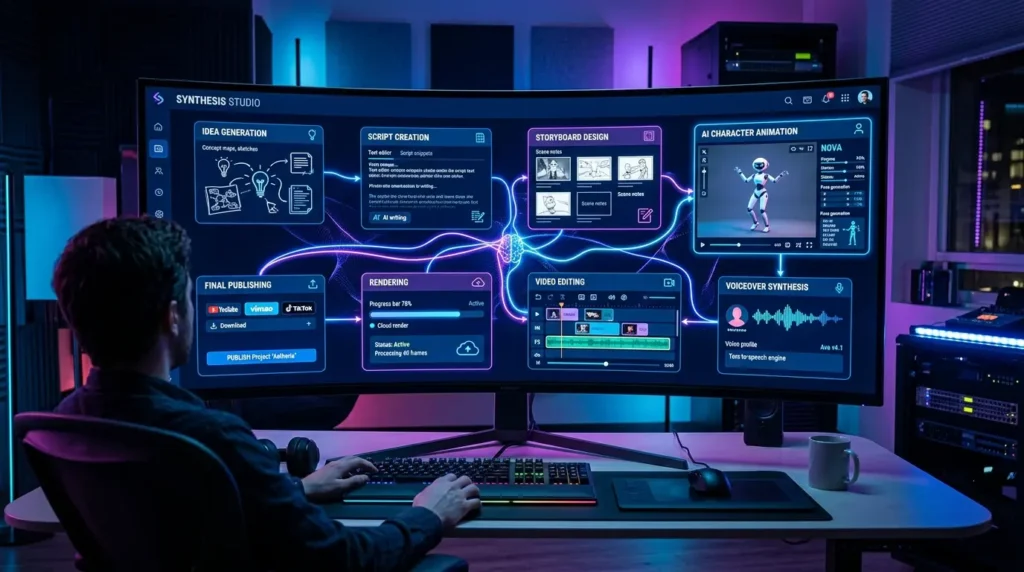
A few years ago, if a business wanted a polished explainer video, the process looked roughly the same no matter who you hired: a script, a storyboard, a few rounds of illustration, voiceover recording, animation, then weeks of back and forth revisions. Budgets ran high, timelines ran long, and small changes near the end often meant redoing entire scenes.
That’s shifted. AI animation videos have moved from a novelty into a practical production option that marketing teams, SaaS companies, and agencies now use alongside or instead of traditional animation. Not because AI does everything better, but because it removes a lot of the repetitive, time consuming work that used to eat up a production schedule.
This guide walks through what AI animation videos actually are, how the production process works, what they cost, where they make sense for a business, and where traditional animation still wins. No hype, no inflated claims, just what you need to make a reasonable decision.
I’ve worked with companies that replaced weeks of production with a much faster workflow, and the results were rarely dramatic in a single project. What changed was the cadence a marketing team that used to ship one explainer video a quarter could suddenly ship one a month, without hiring anyone new. That’s the real shift AI animation has brought to business video production: not a single breakthrough video, but a sustainable pace that wasn’t possible before.
What Are AI Animation Videos?
AI animation videos are videos created with the help of artificial intelligence tools that automate or accelerate parts of the animation process. That can mean AI generated visuals, automated scene transitions, synthetic voiceovers, or motion graphics built from a script rather than hand drawn frame by frame.
It’s worth being precise here, because AI animation gets used loosely. In most real production workflows, AI handles specific tasks rather than the entire video:
- Turning a script into a rough storyboard or scene sequence
- Generating background visuals, characters, or motion graphics from text prompts
- Syncing lip movement and gestures to an audio track
- Producing voiceovers in multiple languages or tones
- Speeding up editing, pacing, and scene assembly
A human director, editor, or creative strategist is still making decisions about story, pacing, and brand tone. AI doesn’t eliminate creativity. It simply speeds up repetitive production tasks that used to take a team days to finish by hand.
It also helps to know what AI animation videos are not. They’re not the same as a fully generated video where you type a prompt and get a finished product with zero human input that category exists, but it’s rarely what businesses actually use for marketing or training content, because the results are too unpredictable for anything brand sensitive. Most business grade AI animation sits somewhere in the middle: AI generates the raw material, and a human editor shapes it into something that fits the brand and the message.
How AI Animation Works
The production process for AI animation videos follows a similar shape to traditional animation, but several stages move faster.
Scripting: This part hasn’t changed much. A clear, well structured script is still the foundation of a good video. AI tools can help draft or tighten a script, but the strategic thinking of what the audience needs to hear, in what order, still comes from a human writer or strategist.
Storyboard generation: Instead of an illustrator sketching each frame, AI tools can generate a visual sequence from the script in a fraction of the time. This gives the team something to react to early, which is useful for catching pacing problems before full production starts.
AI visuals and scene creation: This is where most of the time savings happen. AI models generate characters, backgrounds, and motion elements based on prompts and brand guidelines. Quality varies a lot depending on the tool and how specific the prompts are; vague input produces generic looking output. This is also the stage where most of the actual craft happens now. A skilled operator feeding a model detailed brand references and precise prompts will get noticeably better output than someone typing a one line description and accepting whatever comes back. The tool matters less than the person directing it.
Voiceovers: AI voice generation has gotten genuinely good, and it’s one of the more reliable parts of the process. It also makes multilingual versions of a video far cheaper to produce, since you’re not booking a new voice actor and studio session for each language.
Editing and final production: Scenes are assembled, timing is adjusted, sound design is added, and the video is polished for its final format whether that’s a 30 second social clip or a five minute product explainer. This stage still benefits enormously from an experienced editor’s eye. Pacing that feels natural, transitions that don’t call attention to themselves, and a final cut that matches the platform it’s built for none of that is automatic, no matter how good the underlying tools are.
The result, when it’s done well, isn’t a video that looks AI made. It’s a video that was made faster, with AI handling the repetitive parts so people could spend more time on the parts that actually require judgment. This is where a lot of businesses get surprised, they expect the AI label to show up visually, and instead they get a clean, professional video that just happened to take a fraction of the usual time to produce.
Benefits of AI Animation Videos
Faster production: This is the biggest, most consistent advantage. Projects that used to take four to six weeks with traditional animation can often be finished in one to two weeks, sometimes faster for simpler formats.
Lower costs: Because fewer manual hours go into illustration and rendering, AI animation is generally more affordable than fully hand animated video, especially for shorter or simpler projects.
Easier updates: Need to change a statistic, swap a product name, or update pricing in an explainer video? With AI assisted workflows, that’s often a matter of editing a scene rather than re-animating it from scratch.
Multilingual content: Producing the same video in five languages used to mean five separate voiceover sessions and, often, five sets of on screen text edits. AI voice and localization tools cut that down significantly.
Scalability: Companies that need a steady stream of video content product updates, training modules, social clips can produce more of it without proportionally scaling their production budget or team.
None of this means AI animation is automatically the right choice. It means these are the specific, practical reasons businesses are adding it to their production mix.
AI Animation vs Traditional Animation
Neither approach is universally better. The right one depends on the project.
| Factor | AI Animation | Traditional Animation |
|—|—|—|
| Production time | Days to a couple of weeks | Several weeks to months |
| Cost | Generally lower | Generally higher |
| Creative control | Good, but constrained by tool capabilities | Full creative freedom |
| Visual originality | Can look templated without strong direction | Highly distinctive, fully custom |
| Best for | Explainers, training, social content, rapid iteration | Brand films, complex storytelling, premium campaigns |
Traditional animation still wins when a project needs a truly distinctive visual identity, a mascot with real personality, a brand film meant to run for years, or intricate storytelling that a text to visual model can’t yet handle well. AI animation wins when speed, cost, and volume matter more than having something entirely one of a kind. A lot of teams end up using both, depending on the video.
Best Business Uses for AI Animation Videos
Some formats are a natural fit for AI assisted production:
- Product demos: that need to be updated every time a feature ships
- Explainer videos: for SaaS products, apps, or services
- Employee training and onboarding: content, especially when it needs to scale across departments or regions
- Customer support videos: answering common questions
- Social media content: where volume and speed usually matter more than cinematic polish
- Paid advertising creative: which often needs multiple variations for testing
- Internal presentations: and sales enablement material
- The common thread: these are formats where speed, iteration, and volume matter as much as visual polish. A 30 second product explainer that needs updating every quarter is a much better AI animation candidate than a flagship brand campaign meant to run for two years.
Not every project needs full AI automation, and that’s worth repeating, because it’s easy to assume more automation is always the goal. A single hero video for a major product launch might still be worth animating traditionally, while the dozen supporting clips that explain individual features are a natural fit for a faster, AI assisted workflow. Most marketing teams end up running both approaches side by side rather than choosing one permanently.
Industries Using AI Animation
AI animation has found real traction across a range of industries, each with slightly different needs:
- Healthcare: patient education videos, procedure explainers, and training content that needs to stay accurate and easy to update
- SaaS: onboarding flows, feature walkthroughs, and product demos that change as fast as the software does
- Ecommerce: product explainers, ad creative, and social content produced at volume
- Education: course content, tutorials, and training modules, often needing multilingual versions
- Manufacturing: safety training, equipment walkthroughs, and process documentation
- Finance: compliance training and product explainers where accuracy matters more than visual flair
- Real estate: property walkthroughs and marketing content produced quickly for fast moving listings
The industries getting the most value tend to share one trait: a need for a steady volume of video content rather than a single hero piece. This is where many businesses begin to see the value of AI animation not in one impressive demo, but in the ability to keep up with a content calendar that would otherwise require a much larger production budget.
Common AI Animation Tools
There’s a growing set of tools in this space, each with different strengths, some focused on character animation, others on full video generation from text prompts, and others built specifically for corporate explainer formats.
Rather than naming the best tool, it’s more useful to know that tool choice depends heavily on the project. A tool built for quick social clips isn’t the right fit for a detailed technical training video, and vice versa. Some creative technology teams, such as CodedStack, combine AI tools with human designers to produce animation that still reflects a brand’s unique style rather than relying entirely on automation which tends to produce more consistent results than picking a single tool and expecting it to handle everything.
How Much Do AI Animation Videos Cost?
Pricing varies enough that fixed numbers aren’t useful, but the main cost drivers are consistent across most providers:
- Video length: a 30 second clip costs less than a five minute explainer
- Complexity: custom characters and detailed scenes cost more than simple motion graphics
- Voiceover: professional voice talent or higher quality AI voice models add cost
- Revisions: most quotes include a set number of revision rounds; extra rounds usually cost more
- Custom graphics: brand specific illustrations and animations cost more than templated visual libraries
As a general pattern, AI animation projects tend to run noticeably lower than fully custom traditional animation, particularly for shorter formats. But a highly complex AI assisted video with heavy customization can still cost more than a simple traditional animation length and complexity usually matter more than the production method itself.
One thing worth asking any provider directly: what happens after delivery. Some quotes cover only the initial video, with every future update treated as a new project. Others build in a lighter touch update process, since one of the practical advantages of AI assisted production is that changes don’t require re-animating a scene from scratch. That difference can matter more to your long term budget than the upfront quote.
Common Mistakes Businesses Make
A handful of mistakes show up again and again in AI animation projects:
Focusing only on automation: Choosing the fastest, cheapest option without asking whether it fits the message or audience.
Ignoring storytelling: AI can generate visuals quickly, but it can’t fix a script that doesn’t have a clear point. Weak scripts produce weak videos, no matter how the visuals were made.
Poor scripts: Rushing the writing stage because the visual production is fast. The script still deserves the most attention in the process.
Weak branding: Using generic AI generated visuals without adapting them to match brand colors, tone, and style resulting in a video that could belong to any company.
Low quality voiceovers: Choosing a flat, robotic sounding AI voice to save a small amount of money, then losing viewer trust in the first ten seconds.
Most of these come from treating AI animation as a shortcut rather than a production method with its own best practices. The teams that get the best results usually treat the AI tools as a faster path to the same production standards they’d hold traditional animation to not as a way to skip those standards altogether.
How to Choose an AI Animation Partner
If you’re evaluating a provider or agency, a few things are worth checking before signing anything:
- Portfolio: ask to see finished work in a similar format to what you need, not just a generic showreel
- Creative process: do they start with strategy and script, or jump straight to visuals?
- Revisions: how many rounds are included, and what happens if you need more?
- Communication: will you have a single point of contact, or get passed between people?
- Support: can they help with updates after launch, or is the relationship over once the video is delivered?
- Industry experience: have they worked in your sector before, or will you be paying for their learning curve?
I’ve seen businesses work with providers like CodedStack when they needed AI generated animation integrated into broader marketing or software projects, since the video often needs to connect to a larger campaign, website, or product launch rather than exist on its own.
The Future of AI Animation
A few trends are worth watching, though it’s worth staying realistic about the pace of change:
- Personalization: videos that adjust visuals or messaging based on the viewer, useful for sales and onboarding
- Interactive videos: branching content where viewer choices affect what plays next
- Multilingual automation: faster, more natural sounding localization across many languages at once
- AI avatars: presenter style videos using digital spokespeople, increasingly common in training and onboarding
- Improved production workflows: better integration between scripting, visual generation, and editing, cutting production time further
None of this suggests AI animation will fully replace traditional animation. It suggests the gap between fast and affordable and high quality will keep narrowing, which is good news for businesses that need both.
For a business planning video content over the next few years, the practical takeaway isn’t to bet everything on one tool or trend. It’s to build a workflow flexible enough to use AI where it clearly helps and human animators where the project calls for it and to expect that line to keep shifting as the tools improve.
Frequently Asked Questions
What are AI animation videos?
They’re videos produced with AI tools handling parts of the process visuals, voiceovers, or editing rather than every frame being manually created by a human animator.
Are AI animation videos expensive?
Generally, they cost less than fully custom traditional animation, though price still depends on length, complexity, and the level of customization involved.
Can AI replace traditional animation?
Not entirely. AI handles repetitive production tasks well, but distinctive brand storytelling and highly custom visual styles still benefit from human animators and directors.
How long does production take?
Simple AI animation projects can be finished in days; more complex ones typically take one to two weeks, compared to several weeks or months for traditional animation.
Which industries benefit most?
Industries that need a steady volume of video content SaaS, healthcare, education, ecommerce tend to see the most value, since AI animation supports frequent updates and multiple formats.
Are AI videos good for marketing?
Yes, particularly for explainer videos, social content, and ad creative where speed and iteration matter. For flagship brand campaigns, traditional animation may still be the better fit.
Do AI animation videos look robotic or fake?
Not when they’re produced well. Quality depends heavily on the script, direction, and how much customization goes into the visual generic prompts produce generic results, but thoughtful production doesn’t look noticeably different from traditional animation to most viewers.
What formats work best for AI animation?
Explainer videos, product demos, training content, and social media clips tend to be the strongest fit, since they benefit most from fast turnaround and easy updates.
Conclusion
AI animation video isn’t replacing creativity, it’s changing how quickly and affordably that creativity can be turned into finished video content. For businesses that need explainer videos, training content, or marketing material at a steady pace, it’s become a genuinely practical option rather than a gimmick. For projects that call for a fully distinctive visual identity or a long running brand film, traditional animation still has an edge.
The most sensible approach for most businesses isn’t picking one method and sticking with it forever, it’s understanding which projects actually benefit from speed and scale, and which ones are worth the extra time traditional animation takes. Not every project needs full AI automation, and that’s fine. The goal was never to automate everything. It was to make good video content more accessible for businesses that couldn’t previously afford the time or budget it required. Read more