
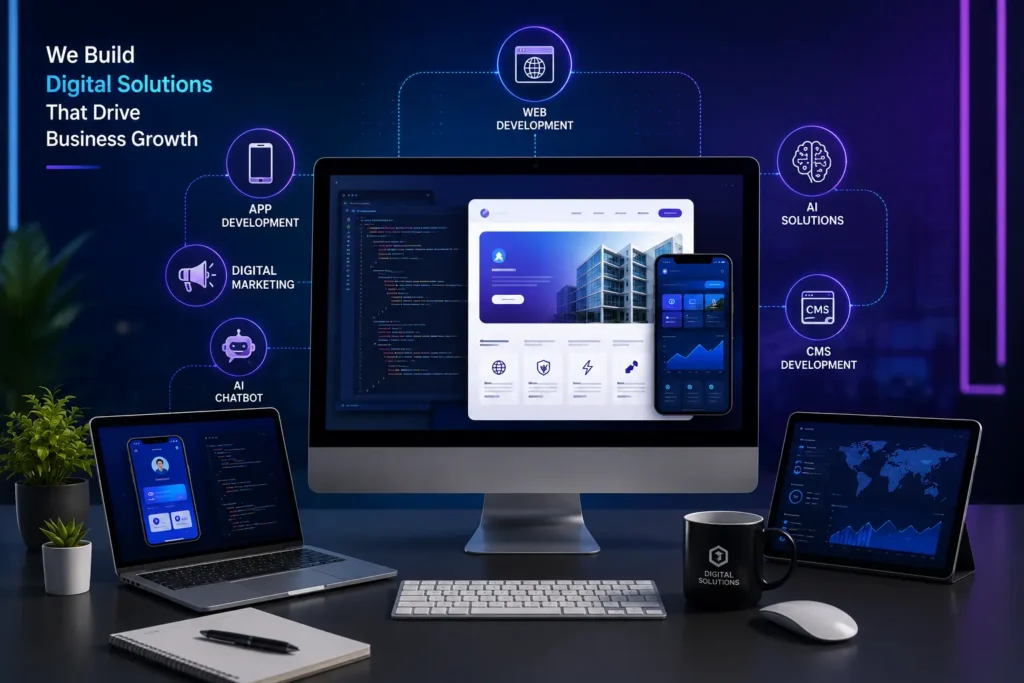
Finding the right technology partner can make or break a business’s digital growth. Whether you’re a startup trying to launch your first website, an ecommerce brand scaling operations, or an enterprise looking to modernize legacy systems, the search usually starts the same way: typing “best digital agency in Florida” into Google and hoping the first few results actually know what they’re talking about.
This guide is meant to cut through that noise. Rather than just telling you why one agency is better than another, we’ll walk through what a modern digital agency actually does, why more businesses are moving away from juggling multiple vendors, what to look for when evaluating your options, and how services like web development, AI, and marketing work better when they come from one coordinated team instead of three disconnected ones.
By the end, you’ll have a clear framework for choosing a partner, not just a list of buzzwords.
What Is a Digital Agency?
A digital agency is a company that helps businesses build, manage, and grow their online presence typically through a combination of web development, software engineering, design, and marketing services. The scope varies a lot from agency to agency. Some specialize narrowly in one thing, like SEO or graphic design. Others operate as full-service partners, capable of handling everything from a custom software development project to the ongoing digital marketing strategy that drives traffic to it.
The distinction matters more than most business owners realize going in. A narrow specialist might do excellent work in their lane, but the moment your project needs something outside that lane, say, your marketing agency can’t touch your website’s backend, or your developer has no idea how to optimize for search, you’re back to managing multiple vendors and hoping they communicate well with each other.
Why Businesses in Florida Need a Full-Service Digital Agency
Florida’s business landscape is unusually diverse: tourism, healthcare, real estate, legal services, ecommerce, and a growing tech and startup scene all operating in the same state, often in the same cities. That diversity creates real demand for agencies that can flex across industries rather than serving just one niche.
There’s also a practical argument for working with one full-service partner instead of separate vendors for development and marketing. When the same team that built your website is also running your SEO and ad campaigns, there’s no finger-pointing when something underperforms, no delay waiting for two companies to sync up, and no inconsistency between how your site is built and how it’s being marketed. A web development company that also understands search engine optimization will naturally build a site that’s easier to rank, rather than handing over a beautiful but technically bloated website that an SEO team then has to fix from scratch.
Services Every Modern Digital Agency Should Offer
A genuinely capable digital agency today needs to cover more ground than it did even five years ago. Businesses aren’t just looking for a website anymore, they’re looking for software that runs their operations, AI tools that save staff time, and marketing that actually converts. Below is a closer look at the core services that separate a full-service agency from a narrow specialist, and why each one matters.
Web Development
At its core, web development is about building a site that works technically sound, fast-loading, mobile-responsive, and structured in a way that both users and search engines can navigate easily. A slow or poorly coded site quietly costs businesses conversions every single day, often without anyone noticing why traffic isn’t turning into leads.
Good website development services go beyond just design. They account for site architecture, page speed, security, and scalability from the start, so the site doesn’t need a costly rebuild the moment the business grows past its original scope.
Full-Stack Development
Full-stack development covers both the front end, what users see and interact with and the back end, which handles data, logic, and server-side operations. Having a team fluent in both sides matters because it allows for more cohesive builds. A front-end-only developer might create a beautiful interface that the back end can’t actually support efficiently, while a back-end specialist might build robust infrastructure with a clunky, unintuitive user experience. Full-stack teams bridge that gap.
Custom Software Development
Off-the-shelf tools work fine until a business’s needs become specific enough that no existing product quite fits. That’s where custom software development comes in building internal tools, client-facing platforms, or automation systems designed around exactly how a business operates, rather than forcing the business to adapt to generic software.
This is particularly relevant for enterprise software development, where the complexity of internal workflows, compliance requirements, and system integrations usually rules out generic solutions entirely.
Mobile App Development
With so much user activity happening on phones, mobile app development has become a serious growth lever rather than a nice-to-have. A well-built app can improve customer retention, create a direct communication channel with users, and offer functionality a mobile website simply can’t match offline access, push notifications, and smoother performance among them.
AI Chatbot Development
AI chatbot development has moved well past the clunky, scripted bots of a few years ago. Modern chatbots can handle customer support queries, qualify leads, schedule appointments, and operate around the clock without adding to a team’s workload. For businesses fielding repetitive customer questions, a well-built chatbot often pays for itself quickly in saved staff hours alone.
AI Automation Services
AI automation services extend beyond customer-facing chatbots into the operational side of a business automating repetitive tasks like data entry, report generation, or internal approvals that would otherwise consume hours of staff time each week. This overlaps closely with business process automation, where the goal isn’t replacing people but freeing them up to focus on work that actually requires human judgment.
CMS Development
CMS development gives businesses the ability to manage and update their own website content without needing a developer for every small change. Whether built on WordPress or a custom content management system, a well-structured CMS strikes a balance between flexibility for the business and the technical guardrails needed to keep the site stable. WordPress development, in particular, remains a popular choice for businesses that want a strong balance of flexibility, cost-efficiency, and ease of use.
Digital Marketing & SEO
None of the above matters much if nobody finds the website or app in the first place. Digital marketing & SEO covers the strategy that drives visibility and traffic technical SEO to ensure search engines can properly crawl and index a site, local SEO services to capture nearby customers searching for relevant services, content strategy, and paid campaigns where appropriate. Search engine optimization services and technical SEO services work best when they’re informed by how the site was actually built, which is exactly why having development and marketing under one roof tends to produce stronger results.
Why Combining Development and Marketing Produces Better Results
There’s a reason more businesses are consolidating their vendors instead of spreading projects across separate development shops and marketing firms. When one team handles both, technical decisions get made with marketing performance in mind from the start, rather than being retrofitted later. A page structure gets built to support SEO instead of needing to be reworked around it. Site speed, which directly affects both user experience and search rankings, becomes a shared priority instead of someone else’s problem.
There’s also a simple efficiency argument. Coordinating between two separate vendors takes time, and time spent syncing up two teams is time not spent actually improving the business. A single accountable partner tends to move faster and catch issues earlier, simply because there’s no handoff gap where things fall through.
Industries We Serve
A genuinely versatile agency should be comfortable working across industries, since the underlying principles of good development and marketing translate even when the specifics differ. Healthcare companies need software and websites built with compliance and data security top of mind. Law firms typically prioritize trust signals, local SEO, and a professional, credible web presence. Real estate agencies often need dynamic listing platforms paired with strong local search visibility, while ecommerce businesses need fast, conversion-optimized storefronts backed by ongoing marketing support. SaaS founders and startups tend to need custom platforms built to scale quickly without accumulating technical debt early on.
The common thread across all of these is that the underlying expertise, solid development practices, thoughtful UX, and marketing grounded in real technical understanding applies regardless of the industry on the surface.
Why Businesses Choose CodedStack
Businesses generally choose to work with CodedStack for the same reason they’d choose any full-service partner worth their time: the ability to handle a project end-to-end without losing quality in any single area. Rather than treating web development, AI integration, and marketing as separate disciplines handled by disconnected teams, CodedStack approaches them as parts of the same strategy, each informing the other.
That said, the right choice for any business ultimately comes down to fit the agency’s experience in your industry, their communication style, and their track record on projects similar in scope to yours. It’s worth evaluating any agency, including this one, against the criteria outlined later in this guide before making a decision.
Project Development Process
A transparent, well-run project generally follows a clear sequence. It starts with discovery, where the agency takes the time to understand the business’s goals, target audience, and technical requirements before proposing a solution. From there, planning and strategy shape the roadmap of what gets built, in what order, and how success will be measured.
Design and development follow, often in iterative stages so the client can see progress and give feedback rather than waiting until the very end to see the result. Testing and quality assurance come next, catching issues before they reach real users. Once the project launches, the relationship shouldn’t simply end; ongoing support, monitoring, and optimization are what keep a website or software system performing well long after the initial build.
Technologies We Use
The right technology stack depends heavily on the project, but a strong agency should be comfortable across a reasonably wide range of tools rather than forcing every client into the same solution regardless of fit. This typically includes modern frameworks for cloud application development, robust API development services for connecting systems and third-party tools, and a working knowledge of AI frameworks for automation and chatbot projects. On the content management side, familiarity with both WordPress and custom-built CMS platforms allows the right tool to be matched to the client’s actual needs rather than a one-size-fits-all default.
UI/UX design services also deserve mention here, since the best technology stack in the world doesn’t matter much if the end product is confusing or frustrating for real users to navigate.
Common Mistakes Businesses Make When Hiring Agencies
A surprising number of digital projects underperform not because of bad execution, but because of avoidable mistakes made during the hiring process itself. Choosing an agency based purely on the lowest price is one of the most common cheaper often means corners get cut somewhere, whether in code quality, design thoughtfulness, or post-launch support. Failing to check past work or client references is another, since portfolio quality and communication style vary enormously between agencies even within the same price range.
Some businesses also underestimate the importance of ongoing support, assuming a website or app is a one-time build rather than something that needs monitoring and updates over time. Others hire separate vendors for development and marketing without considering how much smoother and often more cost-effective it is to work with one coordinated team instead.
Questions to Ask Before Choosing a Digital Agency
Before signing any contract, it’s worth asking a few pointed questions. Can the agency show real examples of past work in your industry, not just generic portfolio pieces? Will the same team handle both development and marketing, or will your project be split between departments with limited communication? What does their post-launch support actually include, and for how long? How do they measure success on a project? Is it just deliverables, or actual business outcomes like traffic, conversions, or efficiency gains? And importantly, how do they communicate during the project? Will you get regular updates, or radio silence until the big reveal?
Future Trends in AI, Web Development, and Digital Marketing
The direction of travel across all three disciplines is toward more integration, not less. AI is increasingly embedded directly into websites and software rather than existing as a separate add-on, think personalized content, smarter chatbots, and automation that adjusts based on real user behavior instead of static rules. Search engines are also evolving how they evaluate content, placing more weight on genuine expertise and user experience rather than keyword density alone, which makes technical SEO and quality content strategy more important, not less.
On the development side, businesses are increasingly expecting software that’s built to scale and adapt rather than static systems that need a full rebuild every few years. The agencies that keep pace with these shifts rather than treating web development, AI, and marketing as separate, static disciplines are the ones likely to keep delivering real value as the landscape keeps changing.
FAQs
What does a full-service digital agency actually do?
A full-service digital agency handles multiple interconnected services, typically web development, software engineering, AI integration, and digital marketing under one team, rather than requiring businesses to coordinate separate vendors for each.
How do I know if I need custom software instead of an off-the-shelf tool?
If your workflows are specific enough that existing tools require constant workarounds, or if you’re paying for features you don’t use while missing ones you need, custom software is usually worth evaluating.
How much does digital agency work typically cost?
Costs vary significantly based on project scope, complexity, and the specific services involved. A simple website costs far less than a custom software platform with AI integration, so it’s worth getting a scoped estimate rather than assuming a flat rate.
How long does a typical web development project take?
Timelines depend on complexity, but a straightforward business website often takes a matter of weeks, while custom software or complex integrations can take several months.
Can one agency really handle web development, AI, and marketing well?
Yes, provided the agency has genuine in-house expertise across each area rather than outsourcing pieces to third parties without oversight. It’s worth asking directly how each service is staffed.
Why should I choose an agency over hiring a freelancer?
Agencies typically offer more consistency, accountability, and breadth of expertise, along with continuity if a single team member becomes unavailable, something a solo freelancer can’t guarantee.
Conclusion
Choosing the best digital agency in Florida isn’t really about finding the flashiest portfolio or the lowest quote it’s about finding a partner whose development work, AI capabilities, and marketing strategy are genuinely coordinated, backed by a transparent process and real accountability. Businesses that treat this decision carefully, asking the right questions and evaluating fit rather than just price, tend to end up with technology and marketing that actually supports their growth instead of creating new problems to manage.
Florida’s market moves fast, and the businesses that grow steadily are usually the ones that stopped treating their website, software, and marketing as separate projects handled by separate people. When those pieces work together from the start, results tend to compound instead of stalling out every time something needs to be re-explained to a new vendor. That’s really the core value a full-service agency offers — not just execution, but continuity.