
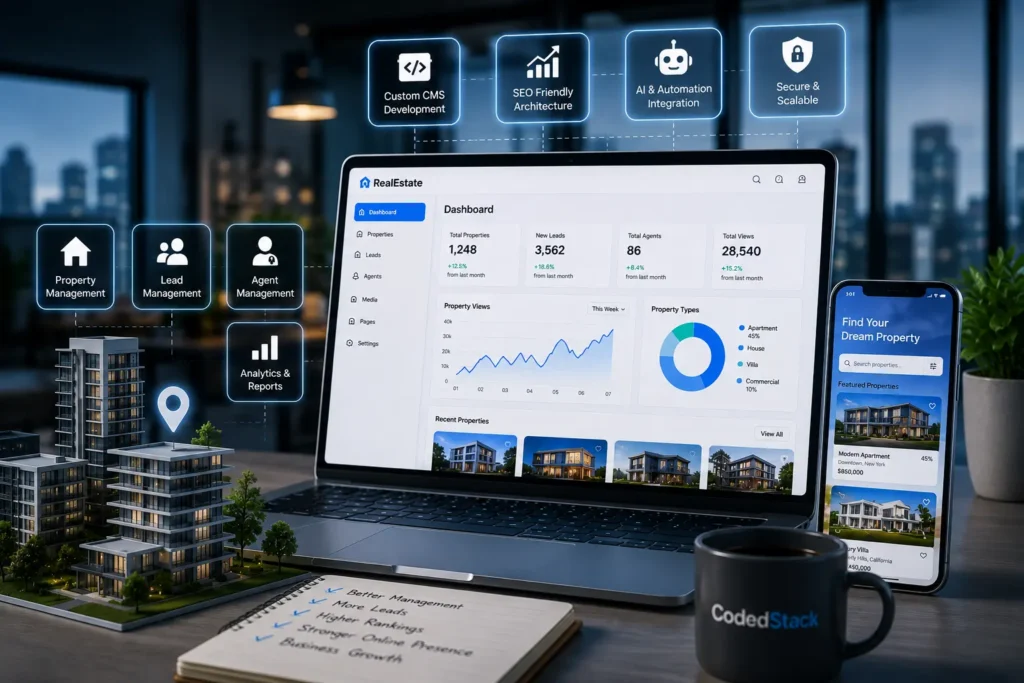
Real estate has always been a relationship business, but in 2026, most of those relationships start online: a buyer scrolling through listings at midnight, an agent updating property details from their phone between showings, or a property manager trying to keep fifty units’ worth of information accurate across three different platforms. The businesses that handle this well tend to have one thing in common: a custom real estate CMS built around how they actually work, rather than a generic website platform they’ve spent years working around.
This guide walks through what a custom real estate CMS actually is, why generic platforms increasingly fall short for growing agencies and property managers, and what to consider from features to cost to timeline before making the investment. Whether you’re running a boutique brokerage or managing a multi-agent enterprise platform, the goal here is to help you make a genuinely informed decision, not just a fashionable one.
What Is a Custom Real Estate CMS?
A Custom Real Estate CMS is a content management system built specifically for how real estate businesses operate managing property listings, agent profiles, lead capture, and integrations with tools like MLS and CRM systems rather than a generic platform retrofitted to handle real estate data.
Unlike a standard website builder, real estate-specific Real Estate CMS Development accounts for the unique structure of property data: square footage, pricing history, neighborhood details, multiple photos and virtual tours, agent assignments, and status changes that need to update instantly across every page a listing appears on. A generic CMS can technically store this information, but it wasn’t designed around it, which is where the friction usually begins.
Why Real Estate Businesses Need More Than a Website in 2026
The expectations around real estate websites have shifted considerably. Buyers expect instant search filtering, accurate real-time availability, and a mobile experience that doesn’t feel like an afterthought. Agents expect to update listings from their phones without waiting on a web developer. Brokerages managing multiple agents need a system where everyone can work independently without stepping on each other’s data.
A basic website simply isn’t built to handle this level of operational complexity. What businesses actually need now is closer to a Real Estate Management Software platform, something that functions as the operational backbone of the business, not just a digital brochure. This is where Real Estate Web Development has evolved: from a marketing asset into genuine business infrastructure.
Problems with Traditional CMS Platforms
Most real estate businesses start with WordPress or a similar general-purpose CMS, and for a while, it works fine. The issues tend to surface as the business grows. Managing hundreds of listings through generic post types becomes clunky, and plugins meant to handle property data often weren’t built with real estate workflows in mind, leading to constant workarounds. Performance frequently suffers too; a site loaded with plugins to simulate real estate features tends to load slowly, which hurts both user experience and search rankings.
Security is another recurring concern. Popular CMS platforms are frequent targets simply because of how widely used they are, and a poorly maintained plugin ecosystem creates more entry points for vulnerabilities. And perhaps most limiting of all, integrations with MLS, IDX, or a real estate CRM often feel bolted-on rather than natively supported, creating data sync issues that quietly cause more damage than most business owners realize until a listing shows outdated information to a buyer.
Benefits of a Custom Real Estate CMS
The advantages of a purpose-built system tend to show up gradually but compound over time. Listings update accurately across the entire site the moment a change is made, rather than requiring manual updates in multiple places. Agents get dashboards tailored to their actual workflow instead of a generic admin panel full of irrelevant options. Integrations with MLS, IDX, and CRM systems work natively rather than through fragile third-party plugins, and performance improves since the system isn’t carrying the weight of unnecessary generic features.
There’s also a scalability argument that matters more than most businesses initially realize. A Scalable CMS built specifically for real estate can grow alongside the business adding new agents, new property types, or new markets without requiring the kind of painful platform migration that often comes with outgrowing a generic system.
Must-Have Features
A genuinely useful real estate CMS needs to cover several core areas well, rather than trying to do everything shallowly. Property listing management sits at the center, alongside agent dashboards, CRM and MLS/IDX integration, lead management tools, and mobile optimization. SEO-friendly architecture matters just as much as any customer-facing feature, since a beautifully built platform that search engines can’t properly crawl won’t generate the traffic it needs to succeed.
Property Listing Management
Property Listing Management is the operational core of any real estate platform. A well-built system allows agents to add, edit, and update listings quickly, with changes reflecting instantly across search results, individual property pages, and any syndicated feeds. Support for multiple images, virtual tours, and detailed property specifications should feel effortless rather than like fighting against a rigid form.
Agent Dashboard
An effective agent dashboard gives each agent a focused view of their own listings, leads, and performance without needing to dig through irrelevant data belonging to other agents or locations. For brokerages managing a Multi-Agent Platform, this kind of separation isn’t just convenient, it’s essential for keeping teams organized as the business scales.
CRM Integration
CRM Integration connects the CMS directly to how leads are actually managed and followed up on. When a buyer submits an inquiry through the website, it should flow straight into the CRM without manual re-entry, ensuring no lead falls through the cracks simply because of a disconnected system.
MLS & IDX Integration
MLS Integration and IDX Integration allow a real estate website to display accurate, real-time listing data pulled directly from official sources. This is one of the areas where generic CMS platforms struggle most, since these integrations often require custom development work that a plugin-based approach can only approximate rather than properly support.
Lead Generation & Lead Management
A custom CMS can be built with lead capture woven directly into the browsing experience inquiry forms tied to specific listings, saved search alerts, and automated follow-ups that keep interested buyers engaged without requiring constant manual outreach. Strong Real Estate Lead Management depends on this kind of tight integration between the website and the systems tracking follow-up, since leads that sit in a disconnected inbox tend to go cold quickly.
SEO Benefits
Search visibility remains one of the most valuable long-term assets a real estate business can build, and this is an area where a custom CMS genuinely outperforms generic alternatives. A SEO-Friendly Property Website built with clean code and proper site architecture from the start avoids the bloat that often comes from plugin-heavy generic platforms, which directly affects both page speed and how easily search engines can crawl and index listings.
Custom-built systems also allow for structured data markup specific to real estate price, location, property type implemented cleanly rather than through a plugin that may or may not follow best practices. Combined with faster load times, this tends to produce meaningfully better organic search performance over time compared to a generic CMS carrying unnecessary technical weight.
Mobile Optimization
With most property searches now happening on phones, mobile experience isn’t optional; it’s often the primary way buyers interact with a listing at all. A custom CMS allows mobile responsiveness to be built into the core architecture rather than patched on afterward, ensuring maps, image galleries, and search filters all function smoothly on smaller screens instead of feeling like a compressed version of the desktop site. This matters even more during actual property viewing trips, when buyers are often pulling up listings on their phones while standing outside a property or driving between showings. A slow or clunky mobile experience at that moment can genuinely cost a business a lead, since frustrated buyers rarely wait around for a page to load properly. For businesses looking to go a step further, pairing a mobile-optimized CMS with dedicated Mobile App Development can offer agents and buyers an even smoother, app-based experience with features like push notifications for new listings or saved search alerts.
API Integrations
Beyond MLS and CRM, real estate businesses often rely on a range of third-party tools, payment processors, e-signature platforms, marketing software, and analytics tools among them. Strong API Integration Services ensure these systems talk to each other properly instead of operating as disconnected silos requiring manual data transfer. This is particularly important for Commercial Real Estate Software, where transaction complexity and document workflows tend to be more demanding than typical residential use cases. Without proper integration, teams often end up manually re-entering the same information across multiple tools, which wastes time and increases the chance of costly errors in contracts or payment records.
Cloud-Based CMS
Running on Cloud CMS infrastructure offers real advantages for real estate businesses, specifically reliability during traffic spikes when a popular listing goes viral, easier scaling as the business adds agents or markets, and simplified maintenance compared to managing physical servers. Cloud Application Development approaches also tend to support better uptime and faster performance overall, both of which matter directly to user experience and search rankings. This becomes especially important for businesses running seasonal marketing campaigns or listing high-demand properties, where a sudden surge in visitors shouldn’t slow the site down or risk it going offline entirely.
AI Chatbots & Automation
AI Chatbot Development Services are increasingly relevant to real estate platforms, handling initial buyer questions, qualifying leads based on budget and preferences, and scheduling property viewings without requiring an agent to be available around the clock. Paired with broader AI Automation Services, tasks like sending listing alerts, following up with cold leads, and generating basic property reports can be automated significantly, freeing agents to focus on the parts of the job that genuinely require human touch negotiations, relationship-building, and closing deals. Even simple automations, like instantly acknowledging a new inquiry while an agent gets notified, can noticeably improve how responsive a business feels to a prospective buyer.
Security & Compliance
Real estate platforms handle sensitive information financial details, personal data, and transaction records making security a genuine priority rather than an afterthought. A custom-built system allows security measures to be designed around the specific risks of the platform, rather than relying on generic plugin security that’s only as strong as its least-maintained component. This matters even more for Enterprise Property Platform deployments, where the volume of data and number of users involved raises the stakes considerably.
Development Process
Building a custom real estate CMS typically follows a clear sequence. It starts with discovery, understanding the business’s specific workflows, agent structure, and integration needs before any design work begins. Planning and architecture follow, mapping out how listings, agents, leads, and integrations will all connect within the system.
Design and development happen next, often in iterative phases so the business can review progress rather than waiting until the very end. Integration work connecting MLS, IDX, CRM, and any other third-party tools tends to be one of the more technically involved stages, followed by thorough testing across devices and use cases. After launch, ongoing support and refinement keep the system running smoothly as the business’s needs continue to evolve.
Development Cost
Costs vary significantly based on scope. A relatively simple custom CMS with basic listing management and standard integrations sits at the lower end of the investment range. A mid-complexity platform with full MLS/IDX integration, CRM connectivity, and agent dashboards requires more investment to reflect the technical integration work involved. A fully custom, enterprise-level platform supporting multiple agents, advanced automation, and complex commercial real estate workflows represents the highest tier of investment, but typically delivers proportionally greater operational value for businesses operating at that scale.
Timeline
Timelines follow a similar pattern to cost. A straightforward custom CMS can often be built within a few months. Mid-complexity platforms with several integrations typically take several months to closer to a year, while enterprise-level, multi-agent platforms with extensive automation and integration work can take a year or longer, often rolled out in phases to avoid disrupting daily operations. It’s worth remembering that the timeline isn’t just about writing code; a meaningful portion of it goes toward testing integrations properly and making sure MLS or CRM data syncs without errors. Businesses that build in buffer time for this stage tend to launch with far fewer post-launch surprises. Rushing past testing to hit an arbitrary launch date is one of the most common reasons an otherwise well-built platform runs into issues in its first few weeks live.
Common Mistakes
A handful of mistakes show up repeatedly among real estate businesses making this transition. Choosing the cheapest development option without checking real integration capability often leads to a system that looks fine on the surface but struggles with MLS or CRM connectivity in practice. Skipping proper planning around agent workflows tends to produce a system that technically works but doesn’t actually fit how the team operates day to day. Underestimating the importance of mobile optimization remains a surprisingly common oversight given how much property browsing happens on phones, and neglecting SEO considerations during development often means paying to fix technical SEO issues later that could have been avoided from the start.
Best Practices
Before starting a custom CMS project, it’s worth clearly mapping your current workflows and pain points rather than assuming a new system will automatically solve undefined problems. Prioritizing MLS, IDX, and CRM integration requirements early prevents costly rework later, and involving agents in the planning process tends to produce a system that actually gets used well, rather than resisted. Planning for future growth of additional agents, new markets, or expanded property types from the outset avoids the need for a disruptive rebuild a few years down the line.
Future Trends for 2026 and Beyond
Real estate technology continues moving toward deeper personalization and automation. AI-driven property recommendations based on buyer behavior are becoming more common, and Property Search Platform experiences are increasingly expected to feel closer to intelligent, personalized search rather than static filtering. Automation is extending further into lead qualification and follow-up, while Real Estate Digital Transformation more broadly is pushing businesses toward fully connected systems CMS, CRM, MLS, and marketing tools all working together rather than operating as separate tools loosely stitched together.
Businesses building a strong technical foundation now, through a properly architected Real Estate SaaS or custom platform approach, tend to be far better positioned to adopt these advances smoothly as they arrive, rather than needing a disruptive overhaul later.
Why Businesses Choose CodedStack
Real estate businesses working with CodedStack typically value having development, integrations, and long-term support handled by one coordinated team rather than juggling separate vendors for the website, the CRM connection, and any automation tools. Whether the need is Custom Property Management System development, MLS and CRM integration, or ongoing Technical SEO and performance support, the goal is building a platform that genuinely fits how the business operates rather than a generic solution that needs constant workarounds.
That said, the right partner for any project ultimately comes down to fit experience with real estate-specific workflows, clear communication, and a transparent development process matter more than any single feature list.
FAQs
What is a custom real estate CMS?
It’s a content management system built specifically around real estate workflows, property listings, agent management, and integrations with MLS, IDX, and CRM systems rather than a generic platform adapted after the fact.
Why not just use WordPress for a real estate website?
WordPress can work for small, simple operations, but often struggles with performance, security, and integration depth as a business grows or requires deeper MLS/IDX/CRM connectivity.
How does a custom CMS improve SEO?
Clean, purpose-built code avoids the performance bloat common in plugin-heavy platforms, which improves both page speed and how effectively search engines can crawl and index listings.
Can a custom CMS integrate with MLS and IDX?
Yes, and typically far more natively than generic platforms, which usually rely on third-party plugins with limited flexibility.
How much does custom real estate CMS development cost?
Costs vary based on complexity, ranging from simpler listing-management systems to fully custom, multi-agent enterprise platforms with deep integrations.
Is a custom CMS more secure than WordPress?
Generally yes, since security can be designed around the platform’s specific architecture rather than depending on the security practices of third-party plugins.
Can a custom CMS handle multiple agents or locations?
Yes, particularly when built with a multi-agent structure in mind from the start, allowing each agent or location to manage their own data independently.
Conclusion
A Custom Real Estate CMS isn’t about chasing the latest technology trend, it’s about building a system that genuinely fits how your business operates, rather than one your team has to constantly work around. From accurate property listings and smooth MLS integration to stronger SEO performance and better lead management, the advantages tend to compound the longer a business relies on the platform.
As real estate technology continues evolving through 2026 and beyond, businesses that invest in a properly built, scalable foundation now are generally in a far stronger position to adapt as buyer expectations and industry tools continue to shift. The businesses that treat this as infrastructure, not just a website, tend to be the ones still scaling comfortably a few years down the line. Ultimately, the decision comes down to how seriously a business takes its own growth. A generic platform might work fine today, but it rarely holds up once agent count, listing volume, or market reach starts expanding.