
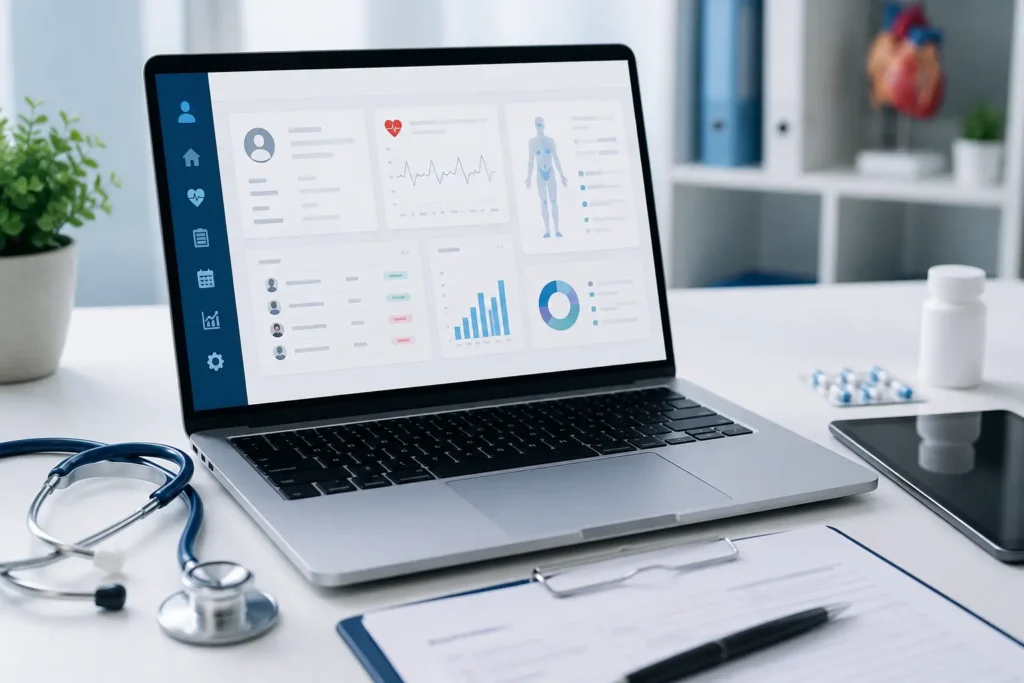
Healthcare is no longer just about clinical expertise, it’s increasingly about technology. From hospitals managing thousands of patient records to startups building telehealth apps, Healthcare Software Development has become the backbone of how modern medical organizations operate, communicate, and deliver care.
If you’re a healthcare provider, hospital administrator, or startup founder trying to understand what goes into building reliable, secure, and scalable medical software, this guide is for you. We’ll walk through everything from the basics of Healthcare Software Solutions to compliance, costs, timelines, and the technologies shaping the future of digital health.
By the end of this guide, you’ll have a clear, practical understanding of how to approach your own healthcare software development journey whether you’re building your first patient portal or modernizing a hospital-wide system.
What Is Healthcare Software Development?
Healthcare software development is the process of designing, building, testing, and maintaining digital applications and systems that support healthcare organizations, including hospitals, clinics, insurance providers, and individual practitioners. It often includes web app development to create secure, scalable, and user-friendly platforms that streamline clinical workflows, improve patient access to services, and enable seamless communication across healthcare systems.
This includes everything from Electronic Health Record (EHR) Software and Electronic Medical Record (EMR) Software to mobile apps that let patients book appointments or consult doctors remotely.
Unlike generic business software, medical software development must account for strict regulatory requirements, patient data privacy, interoperability with other medical systems, and most importantly reliability, since errors in healthcare software can directly affect patient safety.
Why Modern Healthcare Businesses Need Custom Software
Off-the-shelf software often falls short for healthcare organizations because every clinic, hospital, or health-tech startup has unique workflows, patient populations, and compliance obligations.
Here’s why businesses increasingly invest in custom healthcare software:
- Tailored workflows — built around how your staff and patients actually interact with the system, not a generic template.
- Better integration — connects smoothly with existing lab systems, billing software, or insurance platforms.
- Scalability — grows with your organization instead of forcing you into a rigid, one-size-fits-all structure.
- Competitive advantage — a well-designed patient experience often becomes a differentiator in a crowded healthcare market.
- Long-term cost efficiency — no recurring licensing fees for features you don’t need.
Key Features of Modern Healthcare Software
Regardless of what specific system you’re building, certain features consistently define high-quality healthcare IT solutions. Secure, encrypted patient data storage is non-negotiable, as is interoperability and the ability for your system to exchange data with labs, pharmacies, and insurers rather than existing as an isolated island. Appointment scheduling with automated reminders reduces no-shows significantly, and telehealth capabilities built directly into the platform have gone from a nice-to-have to an expectation in most patient-facing systems.
Billing and insurance integration cuts down on administrative overhead, while role-based access control ensures that only authorized staff can view sensitive information. Analytics dashboards help administrators make informed decisions rather than guesses, and mobile accessibility means both patients and providers can use the system wherever they happen to be.
Healthcare Software Development Process
A well-structured healthcare software development process typically follows these stages:
1. Discovery and Requirement Gathering
Understanding clinical workflows, stakeholder needs, and compliance requirements.
2. UI/UX Design
Designing intuitive interfaces for both clinical staff and patients usability directly affects adoption rates.
3. Architecture and Technology Planning
Choosing the right tech stack, database structure, and integration approach.
4. Development
Building the application in iterative sprints, often using Agile methodology.
5. Compliance and Security Testing
Verifying HIPAA compliance, data encryption, and vulnerability testing.
6. Quality Assurance
Rigorous testing across devices, user roles, and edge cases critical in healthcare where errors carry real consequences.
7. Deployment
Rolling out the software, often in phases, to minimize disruption to daily operations.
8. Ongoing Maintenance and Support
Continuous monitoring, updates, and feature improvements post-launch.
Essential Technologies Used
Modern healthcare software solutions are typically built on cloud infrastructure such as AWS, Azure, or Google Cloud, which supports the scalability and reliability that Cloud-Based Healthcare Software requires. Interoperability between medical systems usually relies on HL7 and FHIR standards, which allow different platforms to actually talk to each other instead of operating in silos.
On the front end, frameworks like React, Angular, or Vue.js are commonly used to build responsive interfaces, while the back end is often powered by Node.js, Python, or .NET for secure, stable architecture. Increasingly, AI and machine learning frameworks are being layered in for predictive analytics and diagnostics support, and in select cases, blockchain is used to create secure, tamper-proof medical records.
HIPAA Compliance and Security Best Practices
Perhaps the most critical aspect of any HIPAA-compliant software development project is protecting patient data. HIPAA (Health Insurance Portability and Accountability Act) sets strict rules for how patient health information must be handled in the United States.
Core compliance requirements include:
- Data encryption — both at rest and in transit.
- Access controls — role-based permissions and audit logs.
- Regular security audits — identifying vulnerabilities before they become breaches.
- Business Associate Agreements (BAAs) — with any third-party vendor handling patient data.
- Data backup and disaster recovery plans — ensuring continuity of care during system failures.
Benefits of Custom Healthcare Software
The advantages of investing in a custom-built system tend to show up gradually but meaningfully. Through custom software development, healthcare organizations can create solutions that align with their unique workflows, making patient data more accessible and better coordinated across the care team. Administrative burden drops, freeing staff to spend more time on actual patient care instead of paperwork. Data security can be tailored precisely to your organization’s needs rather than relying on a generic vendor’s approach, and patient engagement tends to rise when portals and apps are genuinely easy to use. Add in the operational efficiency gained through automation, and the long-term scalability that comes from owning a system built specifically for your growth path, and it’s clear why so many organizations eventually make the switch.
Healthcare Software Development Cost
Healthcare software cost varies significantly depending on complexity, feature set, and compliance requirements, so there’s no single number that applies universally. A basic patient management app with limited features and a straightforward scope will naturally cost less and move faster than a mid-sized EHR or EMR system that includes multiple integrations and a full compliance layer. Enterprise-level hospital management platforms, which typically involve numerous integrations, advanced security architecture, and highly custom workflows, sit at the higher end of the investment scale.
The final number is shaped by several factors working together: the number of features and integrations required, the depth of compliance and security work needed, whether the platform covers web, mobile, or both, the location and expertise of the development team, and the ongoing maintenance and support commitment after launch.
Timeline for Building Healthcare Software
Development timelines vary with scope. A simple MVP-style app can typically be built in a few months, while a mid-complexity platform with several integrations tends to take several months to about a year. Enterprise-level systems, especially those rolled out across multiple departments or locations, often take a year or longer and are usually deployed in phases rather than all at once.
AI and Emerging Technologies in Healthcare
AI in healthcare software is transforming how organizations operate:
- Predictive analytics for early disease detection and risk assessment.
- AI-powered chatbots for patient triage and support.
- Automated documentation using natural language processing.
- Remote patient monitoring through IoT-connected devices.
- Personalized treatment recommendations based on patient data patterns.
Key Takeaway: AI works best as an assistant to clinical decision-making not a replacement for human judgment. Successful implementations balance automation with clinical oversight.
Real-World Healthcare Software Examples
To make this more concrete, consider a few realistic scenarios. A multi-location clinic might implement a unified hospital management software system to consolidate scheduling, billing, and records across all its branches instead of managing each location separately. A telehealth startup could build a telemedicine software development platform specifically to connect rural patients with specialists who would otherwise be hours away. A health insurance company might deploy a healthcare CRM software system to improve member communication and speed up claims processing.
These examples look different on the surface, but they all rest on the same core principles: understanding the workflow, prioritizing security, and designing around real user needs rather than assumptions.
Common Mistakes Businesses Should Avoid
Some mistakes show up again and again across healthcare software projects. Skipping compliance planning until late in development is one of the most costly, since it often forces expensive rework once gaps are discovered. Ignoring end-user feedback during design tends to result in low adoption rates, no matter how polished the final product looks. Underestimating data migration complexity is another common trap, especially when replacing legacy systems that have years of accumulated, messy data. Failing to consider cross platform development early in the project can also limit accessibility and create inconsistent user experiences across web, mobile, and desktop devices. Choosing a vendor based on price alone often sacrifices quality and long-term support, and neglecting post-launch support entirely assumes the software will just keep working perfectly on its own, which it rarely does.
Expert Tips Before Starting a Healthcare Software Project
- Clearly define your compliance requirements upfront.
- Involve clinical and administrative staff early in the process.
- Prioritize interoperability from the start.
- Choose a development partner with proven healthcare software development services experience.
- Plan for scalability, not just current needs.
- Budget for ongoing maintenance, not just initial development.
Frequently Asked Questions
What is healthcare software development?
It’s the process of designing and building digital tools such as EHR systems, patient portals, and telehealth platforms tailored to healthcare organizations’ clinical and administrative needs.
How much does healthcare software cost?
Costs vary widely based on complexity, features, and compliance needs, ranging from simple apps to enterprise-level platforms.
How long does it take to build healthcare software?
Timelines range from a few months for simple MVPs to over a year for complex, enterprise-grade systems.
Is HIPAA compliance mandatory for all healthcare software?
Yes, any software handling protected health information (PHI) in the U.S. must comply with HIPAA regulations.
What’s the difference between EHR and EMR software?
EMR software digitizes records within a single practice, while EHR software enables sharing patient data across multiple providers.
Should I build custom software or buy an existing solution?
It depends on your workflow complexity, budget, and long-term scalability needs. Custom solutions offer more flexibility but require higher upfront investment.
Conclusion
Healthcare software development is far more than writing code; it’s about building systems that improve patient care, streamline operations, and protect sensitive data, all while navigating strict regulatory requirements. Whether you’re a hospital modernizing legacy systems, a clinic building a patient management software solution, or a startup entering the healthcare SaaS development space, success depends on careful planning, the right technology choices, and a partner who understands both the technical and clinical sides of healthcare.
Investing in scalable, secure, and user-centric healthcare software today helps organizations stay competitive while adapting to evolving patient expectations and industry regulations. A well-designed custom solution not only improves operational efficiency but also lays the foundation for future innovations such as AI-driven diagnostics, remote patient monitoring, and data-driven decision-making. By choosing the right healthcare software development strategy, organizations can deliver better patient experiences, reduce costs, and achieve sustainable long-term growth.